
Transporting an MTG Cube: Box Fit, Tokens, Lands, and Damage Control
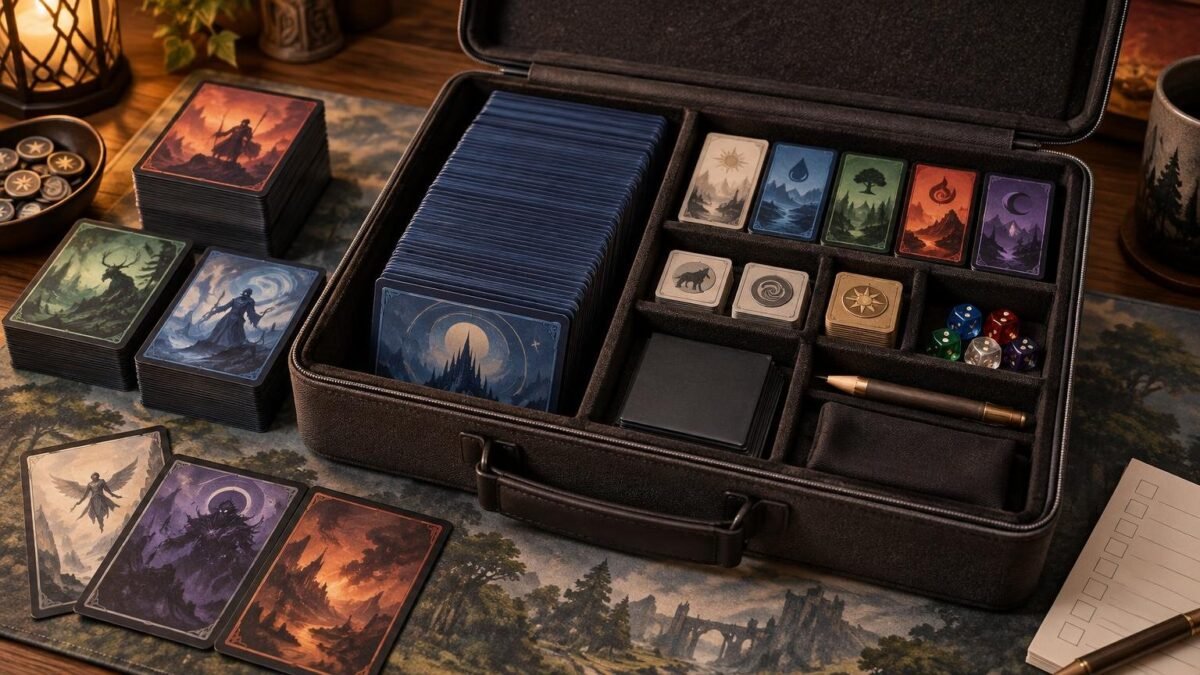
Table of Contents
TLDR
To transport MTG cube safely, use a rigid, closable container that holds the sleeved cards snugly without compressing them. Separate the draft pool from basic lands, tokens, dice, spare sleeves, and cards found after cleanup. Carry a current list, assign a simple post-draft collection routine, and audit the contents after travel. The safest system is not merely a strong box; it is a repeatable process that prevents loose cards, mixed components, missing sideboards, and rushed repacking.
Treat the Cube as a small traveling game library. Its container handles impact and movement, while your organization system handles the more common operational risks: cards left in deck boxes, basics shuffled into the main pool, tokens mistaken for draftable cards, and returned decks preserving color or archetype clumps.
How to transport MTG cube safely
Start with a rigid container that closes securely and fits the entire sleeved draft pool. Cards should remain upright or flat according to the container’s intended orientation, with enough support that they cannot slump into open space. Avoid an excessively tight fit: pressure on the first and last cards can curl sleeves, catch corners, and make removal difficult.
If the container has unused space, fill it with a stable divider or a separate accessory compartment rather than allowing cards to slide. The divider should have smooth edges and should not press into the card faces. Test the packed box by gently changing its orientation over a table. If the cards shift significantly, revise the fit before traveling.
A box does not make its contents crushproof, waterproof, or heatproof. Keep it out of direct sun, do not leave it in a hot vehicle, and protect it from drinks and rain with an outer bag appropriate for the trip. When traveling by car, place it where it cannot become a sliding weight. For broader container and sorting considerations, see the Cube storage and travel setup guide.
Use a short departure checklist
- Main Cube count or verified section count
- Basic lands in their assigned compartment
- Tokens, emblems, and reminder cards
- Dice, counters, and other gameplay accessories
- Spare sleeves matching the Cube sleeves
- Current Cube list and version label
- Empty compartment or pouch for cards found during cleanup
- Outer bag or other protection suited to the journey
Separate the draft pool from the support kit
The most useful organizational boundary is simple: draftable cards belong in the main Cube pool; everything else belongs somewhere visibly different. PrintACube recommends consistent sleeves throughout a Cube, a sturdy storage solution, and organized access to basics and tokens. It also notes that basics can be carried separately or included to make the Cube self-contained.
| Component | Recommended location | Reason |
|---|---|---|
| Draftable Cube cards | Main fitted compartment | Defines the pool that must be counted and randomized |
| Basic lands | Separate labeled section | Prevents basics from being shuffled into the Cube |
| Tokens and emblems | Dedicated pouch or divider | Makes support pieces easy to distribute and recover |
| Dice and counters | Closed accessory compartment | Keeps hard objects away from card faces and edges |
| Spare sleeves | Small labeled pack | Supports immediate replacement without changing sleeve type |
| Found cards | Temporary return compartment | Prevents late discoveries from entering the wrong section |
Hard accessories should not move freely beside cards. Dice can mark sleeves or card surfaces when a box is shaken. Put them in a closed pouch or isolated compartment. Tokens and reminder cards are less dangerous physically, but mixing them into the draft pool creates pack-collation and inventory problems.
Keep the main Cube in one sleeve system
Use the same sleeve model and color across the draftable pool. Consistent sleeves make the cards easier to handle as one library and reduce the chance that a changed card becomes identifiable from its back. PrintACube specifically recommends one sleeve type for a consistent shuffle feel.
Carry more replacement sleeves than you expect to need. If one splits during deck building, replace it immediately and set the damaged sleeve aside. If matching sleeves are unavailable, do not introduce an obvious temporary sleeve into a hidden-information draft. A placeholder can work during casual games if the group agrees, but it should be corrected before the next draft.
Protective finishes and sleeves reduce routine handling wear; they do not justify rough packing or claims that cards are immune to water, heat, crushing, or scuffs. PrintACube describes its printed cards as having a protective finish and being intended for sleeved, repeated play, but that is a handling description rather than a durability guarantee.
Set table procedures before opening packs
A two-minute briefing prevents a long search later. Tell players where basics and tokens live, where sideboards should remain, and how cards should be returned. If the Cube uses double-faced cards, explain whether players draft the physical card, use a checklist or helper card, or keep a reference version nearby. Apply one procedure consistently so every double-faced card remains identifiable and recoverable.
Give each player a defined area for drafted cards and a separate location for basic lands and support pieces. Discourage mixing personal cards, trades, or Commander decks into that area. Visual boundaries are more reliable than asking eight people to remember which identical sleeve came from which box.
For a conventional eight-player draft, three 15-card packs per player require 360 Cube cards. Wizards describes traditional Booster Draft for up to eight players and the familiar left-right-left passing sequence. Its baseline uses roughly 45 drafted cards per player before building a deck of at least 40 cards. The official Booster Draft overview is useful when introducing players to that structure.
That 360-card figure is a setup reference, not a requirement for every Cube night. Two- to four-player formats expose different portions of the pool and need their own preparation. Choose a method from Cube draft formats for two, three, and four players before deciding how much of a larger Cube to transport or randomize.
Run the same return routine after every draft
Cleanup should happen in stages rather than through one communal pile. First collect main decks and sideboards. Then remove basic lands. Gather tokens and helper cards separately. Finally, check play areas, chairs, deck boxes, bags, and the floor before anyone leaves.
- Ask each player to combine drafted cards from their deck and sideboard.
- Remove all basic lands and return them to the land section.
- Remove tokens, emblems, helper cards, and personal cards.
- Place every returned Cube card into one collection area.
- Check the room and accessories for stragglers.
- Compare the returned pool with the expected count or section totals.
- Record any missing or damaged card immediately.
- Put cards found later into the return compartment until they can be verified.
Do not rely on memory when a card is missing. Record its name, the date, the group, and the last place it may have been seen. A written missing-card log prevents the same uncertainty from resurfacing at the next session.
Choose an inventory check that matches the risk
A full count after every casual session is thorough but may be more work than some groups will sustain. Use a quick count after routine drafts when the return process was controlled. Perform a full count or section-by-section audit after travel, a large event, an interrupted cleanup, a suspected loss, or any session involving unfamiliar players.
If the Cube is organized into numbered sections for storage, count each section before recombining it. This localizes an error. Counting only the grand total can confirm that something is wrong without showing where to look. PrintACube’s maintenance guidance includes card-count verification, removing basics, and reinserting sideboard cards during reset work.
Reset the Cube instead of storing returned decks intact
Returned decks are structured clumps. Their cards have been selected by color, curve, synergy, and archetype, while unused sideboards may preserve another kind of selection. Putting those stacks directly into storage can carry that structure into the next pack build.
Break the cards into manageable piles, redistribute cards among those piles, recombine them in a different order, and shuffle again. This is a practical workflow rather than proof of statistically perfect randomness. It is especially useful after sorted storage, substantial updates, or drafts returned in deck-shaped, color-based, or archetype-based groups. A deeper explanation appears in the guide to common Cube randomization mistakes.
Do not “fix” suspicious packs by manually balancing every color unless curated packs are an intentional rule of the environment. Randomization and collation policy are design choices. If you seed packs, document the method so it can be repeated rather than improvised.
Maintain a master list and version history
Physical control becomes much easier when the Cube has a current master list. Give each stable configuration a date or version label. Before making changes, save a snapshot; pair additions with cuts; and note why each swap was made. Keep removed cards in a labeled archive rather than mixing them with unrelated cards. These practices match PrintACube’s update guidance.
A useful change log records the incoming card, outgoing card, date, reason, intended archetype or role, and exact version when artwork or printing matters. The reason can be brief: lower the curve, improve discard overlap, reduce repetitive gameplay, or replace a damaged play piece.
For update cadence, PrintACube suggests fixing clear gameplay or rules problems immediately, reviewing minor concerns after about three drafts, making ordinary updates after roughly three to five drafts, and considering a larger review after eight to ten drafts. Treat those intervals as defaults. A Cube drafted weekly produces evidence faster than one played twice a year, and a complex experimental environment may benefit from smaller, more isolated changes.
Prepare replacements as a controlled batch
Keep a replacement list separate from the full master list. Include card name, set and collector number when the exact printing matters, quantity, double-faced-card instructions, and any required token. PrintACube states that it accepts Cube Cobra exports and simple lists, recommends set and collector-number details for exact versions, and allows changed cards to be reprinted without reproducing the whole Cube.
Printed Cube cards and replacements should be treated as unofficial proxy play pieces, not authentic collectibles. PrintACube identifies its products that way and states that it is not endorsed by Wizards of the Coast. If another project calls for a separate source of custom MTG card printing, keep its files and version records distinct from the Cube master list.
A repeatable travel workflow
The best damage-control system has three checkpoints. Before departure, verify the box fit, component compartments, count, and version. At the table, establish boundaries for drafted cards, basics, tokens, and personal cards. After play, recover cards in stages, document problems, audit the pool, and break up returned deck clumps before building future packs.
Start by writing a checklist that fits on one screen or index card. Run it at the next draft without adding extra steps midstream. If the group consistently skips a step, simplify it or assign it to a specific person. A transport system succeeds when it remains easy enough to use after the final match, when everyone is tired and ready to leave.
References
- Frequently Asked Questions – Print A Cube | MTG Proxy Printing
- Our Printing – Print A Cube | MTG Proxy Printing
- MTG Booster Draft | Magic: The Gathering
- How to Update an MTG Cube Without Reprinting the Whole Thing – Print A Cube | MTG Proxy Printing
- Top 10 MTG Cube Randomization Mistakes That Make Drafts Feel Weird – Print A Cube | MTG Proxy Printing
- Print Your Own MTG Cube: Upload Checklist Before You Order – Print A Cube | MTG Proxy Printing
- Cube Cobra Export: How To Export A List For MTG Cube Printing – Print A Cube | MTG Proxy Printing
- Shipping & Delivery – Print A Cube | MTG Proxy Printing