
This post helps cube owners store and transport an MTG cube without card damage or setup chaos by explaining container options, sorting systems, and a few proven “grab-and-go” travel kits, so cube night stays the easy kind of Magic.
TLDR
- Pick a home state for your cube: sorted for maintenance or draft-ready for speed. Most people need both, at different times.
- Choose storage based on your real load (cube size + sleeves + basics + tokens), not the number printed on the box.
- The cleanest setups separate the cube, the basic lands, and the draft accessories into predictable compartments.
- For travel, prioritize compression + dividers + a shoulder strap. Your cube should not become a loose-brick physics experiment.
- If you want the fastest setup, use pack containers (reusable “packs” or small deck boxes) and keep your cube draft-ready between nights.
Why cube storage feels harder than it should
If you’ve ever carried a cube in a shoebox (respect), you already know the problem: a cube is not just “a stack of cards.” It’s a stack of cards plus sleeves, plus lands, plus tokens, plus the stuff you only remember after you arrive.
And if you want to store and transport an MTG cube like a normal human, you need a system that survives three moments:
- storage on a shelf, 2) the trip to game night, and 3) the post-draft cleanup when everyone is sleepy and someone is still talking about their Turn 2 nonsense.
Let’s make it clean.
How to store and transport an MTG cube: start with the home state
Before you buy a box, decide what your cube looks like when it’s “at rest.”
Home State A: Sorted (best for updates and balance work)
What it is: Cards are organized by section (Color, Multicolor, Artifacts, Lands, etc.) with dividers.
Pros
- Updating the list is painless
- Counting and auditing is easy
- You can spot problems (like “why do I have 14 five-drops in blue?”)
Cons
- Draft setup takes longer (you must shuffle a lot)
- You will constantly re-sort if you draft often
Use it when: you tweak your cube regularly, swap modules, or do frequent maintenance.
Home State B: Draft-ready (best for weekly play)
What it is: The cube is already randomized, sometimes even pre-packed into “boosters.”
Pros
- Fastest setup and teardown
- Great for travel and recurring cube nights
- Less “we lost 12 cards somewhere” risk (because you handle smaller chunks)
Cons
- Updating the cube takes more effort
- If something goes missing, it is harder to notice immediately
Use it when: your cube list is stable and you draft often.
The simple rule I recommend
- If you draft monthly or more, keep your cube draft-ready most of the time.
- If you update weekly or more, keep your cube sorted most of the time.
- If you do both, store it sorted, then do one big “shuffle + pack” session the day before cube night.
Choose a container based on your real load
Here’s the part most people skip: the cube is rarely just “540 cards.”
Your real load is usually:
- Cube cards (360/450/540/720)
- Sleeves (single or double)
- Basic lands (often 120–200 if you host regularly)
- Tokens/dice (and maybe a few spare sleeves)
A quick sizing trick that never lies
Take 100 of your sleeved cards, square them up, and measure the thickness with a ruler.
Now multiply by (cube size ÷ 100), then add 10–20% for air, dividers, and “stuff you will absolutely bring.”
It’s boring, and it works every time.
Storage options that actually work (with tradeoffs)
Below are common “tiers” of cube storage. The right answer depends on how much you travel and how much you hate re-packing.
| Option | Best for | Pros | Cons |
|---|---|---|---|
| Cardboard long box (trading card storage) | budget shelf storage | cheap, stackable, easy to label | weak for travel, dividers can shift |
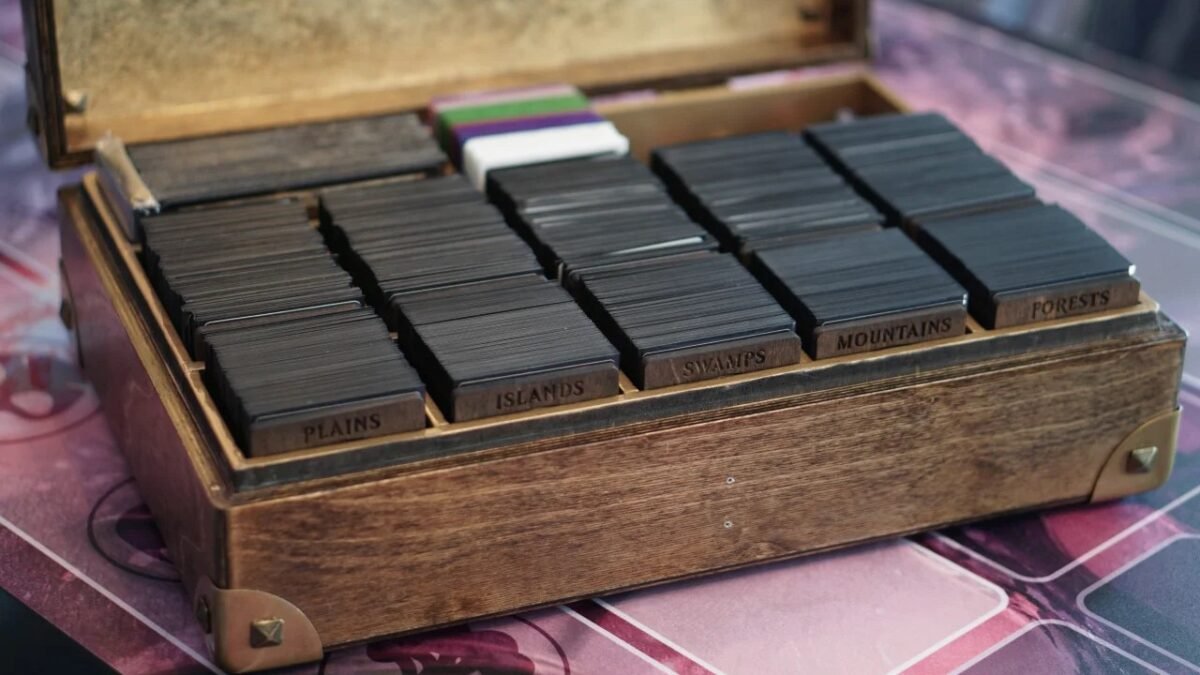
| All-in-one game chest (compartments for cards + accessories) | one-box hosting | everything in one place, tidy compartments | bulkier, can be heavy when full |
| Dedicated travel case (shoulder strap + dividers) | frequent travel | easiest to carry, stable in transit | less “one big tray” convenience |
| Modular pack system (small boxes that act like packs) | fastest setup | instant packs, tidy cleanup, great for travel | upfront effort, updating takes longer |
Real-world capacity examples (useful benchmarks)
- Large “game chests” often advertise space for around a full 540-card cube plus room for accessories, depending on sleeves and how you partition it.
- Travel cases can comfortably carry a full cube plus lands if you keep things segmented (dividers matter more than raw volume).
The point is not the brand. The point is: your cube should not slide.
Sorting systems that stay sane
Now let’s answer the question behind the question: “How do you sort out a cube for MTG without hating your life?”
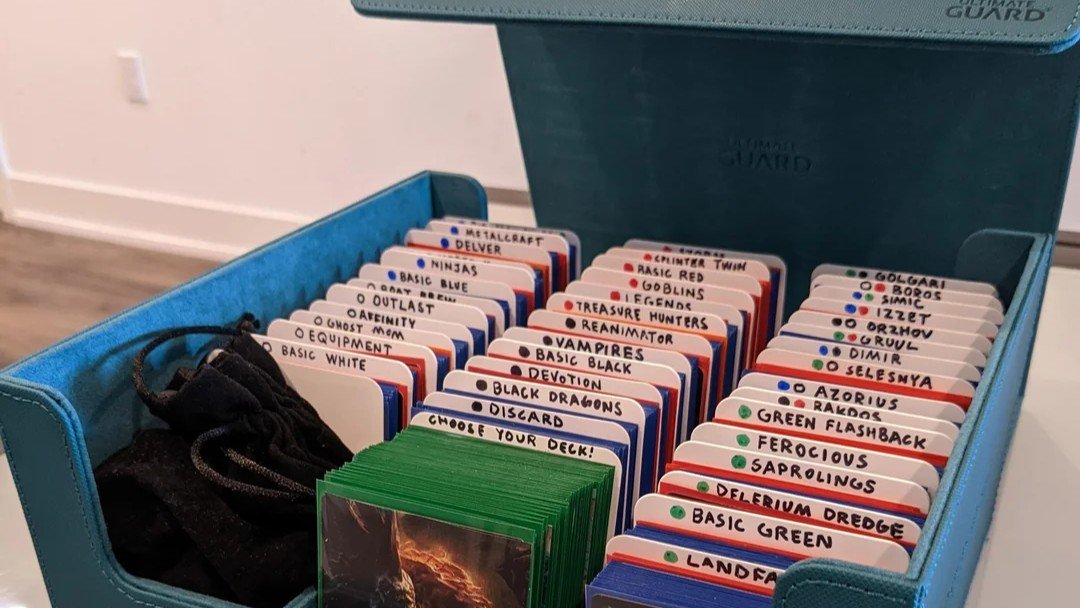
System 1: Section dividers (the maintenance-friendly default)
How it works: You store by section and use labeled dividers.
I’d label like this
- White / Blue / Black / Red / Green
- Multicolor
- Colorless (Artifacts)
- Lands (nonbasic)
- Tokens (if you store them here)
- “Needs review” (a small quarantine slot for damaged sleeves, misprints, oddballs)
Best for: people who update lists, tune archetypes, or like order.
System 2: “Two bins” sorting (fastest cleanup)
How it works: After a draft, do a quick sort into:
- Cube cards
- Non-cube cards (basics, tokens, borrowed sleeves, random strays)
That’s it. Do the real sorting later, at home, with a drink and fewer opinions in the room.
Best for: hosts who want a fast teardown.
System 3: Pack containers (draft-ready mode)
This is the travel-and-speed solution.
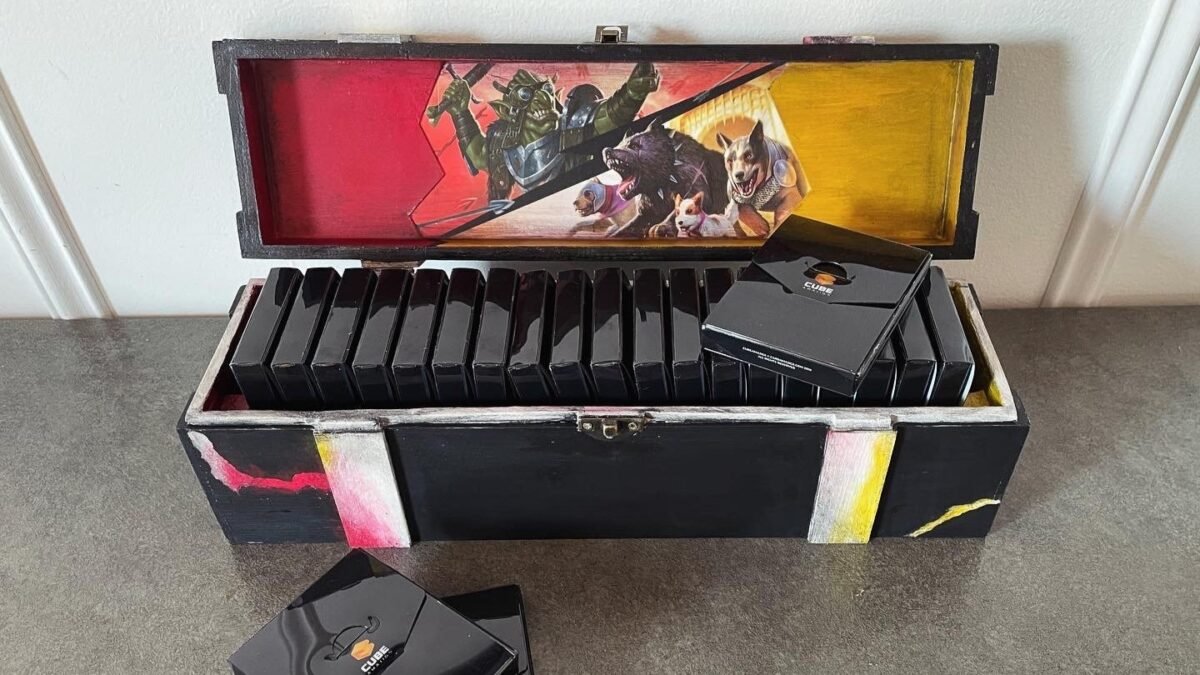
How it works: You keep your cube pre-divided into “pack-sized” chunks using reusable pack boxes or small containers. On draft night, you grab 24 packs, done.
Best for: frequent cube nights, travel, and anyone who hates pack building.
The tradeoff: updates are more annoying. You will eventually schedule a “re-pack day.”
Three travel setups you can copy
These are “known good” patterns. Pick the one that matches how you actually cube.
1) Backpack setup (minimal, flexible)
Bring
- Cube (in one secure box)
- Small land bundle (in a compact separate box)
- Dice + a few tokens
Why it works: light, simple, good for showing up at someone else’s house.
2) Shoulder-strap travel case (best overall for repeat nights)
Bring
- Cube, divided so it cannot slide
- Lands in their own compartment
- Accessories in a fixed pocket
Why it works: stable in transit, easy to carry, faster than juggling multiple boxes.
3) Host chest (the “cube night lives here” setup)
Bring
- Cube
- Lands
- Tokens
- Dice
- Spare sleeves
- A pen and paper (because someone always wants to track results)
Why it works: everything is in one place, and cleanup becomes “put it back where it goes.”
The grab-and-go cube kit checklist
If you want to never forget the basics again, pack these as a permanent kit:
- Cube
- Basic lands (or a plan for them)
- Tokens you actually see in your environment
- Dice (a few d6 and at least one life method)
- Spare sleeves (10–20 is plenty)
- Pen + small notepad (draft notes, standings, “who has my card?”)
- Optional: pack containers, playmat, small trash bag (the real pro tech)
Small print notes that affect storage
Printing is only relevant here in one way: consistency.
If your cards are consistent in size and feel, they:
- sleeve uniformly,
- stack cleanly,
- fit boxes predictably,
- and shuffle without catching.
That makes storage and transport easier because your cube behaves like one cohesive object instead of 540 tiny surprises.
FAQs
What’s the best thing to hold an MTG cube in?
The best option is the one that keeps the cube from sliding and also matches your routine. If you travel often, a divided travel case is usually the easiest. If you host at home, a compartment-style chest is the cleanest.
How big of a box do I need for a 540-card cube?
Big enough for the 540 cards plus sleeves plus whatever else you bring. The most reliable method is measuring 100 sleeved cards and scaling up, then adding 10–20% for dividers and accessories.
Should I store my cube sleeved?
If you draft regularly, yes. Sleeves protect the cards and make shuffling smoother, which matters a lot when you are handling hundreds of cards.
Should I store my cube sorted or randomized?
Sorted is best for maintenance and updates. Randomized (or pre-packed) is best for fast drafts. Many hosts alternate: sorted during the week, draft-ready for game night.
What’s the fastest way to transport a cube for weekly drafts?
Pre-pack your cube into pack-sized containers, keep lands separate, and use a case with dividers so nothing slides. Fast setup is mostly about avoiding the “re-shuffle the whole cube” moment.