
This post helps MTG cube designers borrow Return to Ravnica’s two-color draft architecture and guild mechanics so their drafts create cleaner lanes, better games, and fewer “four-color goodstuff” accidents.
TLDR
- Return to Ravnica (RTR) is a masterclass in two-color incentives: gold rewards you for committing, while hybrid, Gates, and Keyrunes keep you from getting punished for doing so.
- The five guild mechanics are simple, legible, and deck-shaping, which is exactly what you want from “signposts” in cube.
- RTR supports big plays by making early boards stall more often, giving expensive cards time to matter.
- Steal the pattern: tighten gold costs to define lanes, then add a safety net (fixing, flexible playables, late-game mana sinks).
- If you want RTR vibes in cube, aim for clear archetypes, honest fixing, and a few high-mana haymakers that actually get cast.
Return to Ravnica is one of those sets that feels “obvious” in hindsight: of course a guild set should draft into clean two-color decks, of course the mechanics should scream their guild identity, of course the mana should help you do the thing. But RTR is special because it hits all of that without turning drafts into paint-by-numbers.
This Return to Ravnica design review is about what RTR nailed, and how you can steal those wins for cube without having to build a full-on RTR set cube.
What RTR Got Right: Two-Color Lanes That Stay Two-Color
Guild sets have a built-in failure mode: everyone first-picks gold cards, nobody can cast them, and the draft devolves into “play all the fixing and hope.” RTR dodges that by using two competing forces that you can copy directly into cube:
1) Pressure to commit (the “reward” side).
RTR’s gold cards are often the best rate, but they ask real questions of your mana. That’s not a bug. It’s how the set teaches you to be Azorius or Rakdos instead of “Blue with a splash of whatever I opened.”
2) A safety net (the “don’t get punished” side).
RTR then gives you multiple ways to still function when your draw is imperfect: Gates to smooth, Keyrunes to bridge to the midgame and become real threats, and hybrid costs that play like “two-color artifacts” in exactly the decks they’re meant for.
For cube design, the big takeaway is that lane integrity is a dial, not a vibe. If you want guild drafting to feel real, you need both:
- Gold that is worth committing to, and
- Fixing and flexibility that prevent trainwrecks.
If you only do the first, newer drafters get punished hard. If you only do the second, everyone drafts 4–5 colors and your guild identity turns into wallpaper.
The Guild Mechanics Are Doing More Work Than You Remember
RTR’s five keywords are a clinic in “mechanics that explain themselves,” and that matters a ton for cube. In a cube draft, players are already processing unfamiliar card pools, signals, and archetypes. The last thing you want is a mechanic that requires a rules seminar before it plays well.
Here’s what RTR’s mechanics do in cube terms:
- Detain (Azorius): A tempo tool that lets a “fliers + pressure” deck force damage through and win races. It pushes Azorius away from pure durdle and into proactive play.
- Overload (Izzet): A clean mana-sink pattern: early it’s a normal spell, late it’s a blowout. This is one of the best “scale with the game” designs ever printed.
- Unleash (Rakdos): A simple fork: do you want size now, or defense later? In practice it says, “Rakdos is the beatdown,” and it does it without extra board complexity.
- Scavenge (Golgari): Graveyard value that turns dead creatures into future pressure. It also plays nicely with evasive creatures and combat keywords, which creates lots of small “combo moments” without needing a combo deck.
- Populate (Selesnya): Token snowballing that asks for real support. Populate is powerful when the environment is built for it, and underwhelming when it isn’t. That’s a useful lesson, not a flaw.
If you’re building a cube and you want archetypes to be draftable, RTR is basically screaming: give each lane an identity mechanic, then make sure commons and uncommons actually support it.
Big-Mana Cards Actually Matter in RTR (And Why That’s Rare)
One thing that jumps out when you look at RTR’s higher-rarity pool is how much of it lives above the cheap curve. On Scryfall, there are 68 rares and mythics in RTR, and 38 of them have mana value greater than 3. That’s a meaningful tilt toward “midgame and late-game cards that do something.”
That matters because big-mana cards only feel good when the environment lets them exist. RTR does that in a few subtle ways:
- Board states stall more often because lots of creatures naturally block well.
- Mana smoothing exists, so hitting land drops is more realistic.
- Mechanics like Overload give you a reason to keep playing lands.
Cube translation: if you want seven-drops to be exciting instead of embarrassing, you need to pay for it somewhere. Usually that payment is:
- fewer hyper-efficient one-drops, or
- more stabilizing interaction, or
- more mana help, or
- all three.
If your cube is tuned to “critical turn 4,” your five- and six-drops need to either stabilize immediately or basically win the game. RTR-style big spells are often slower and swingier. That’s fine, but you have to build the runway.
Return to Ravnica Design Review Takeaways for MTG Cube
Here’s the “steal this for cube” framework I’d actually use. It’s not about copying RTR card-for-card, it’s about copying the levers.
| RTR design lever | What it does in Limited | How to steal it for cube | Tradeoff to watch |
|---|---|---|---|
| Gold cards with real color costs | Rewards commitment and defines lanes | Use gold as a signpost + payoff, not as filler | Too much gold creates “can’t cast spells” drafts |
| Hybrid as flexibility | Lets two-color decks cast “gold-ish” cards more often | Use hybrid/pseudo-hybrid to reduce trainwrecks | Too much flexibility blurs lanes |
| Gates + “mana helpers” (like Keyrunes) | Fixes mana, bridges to late game, adds playables | Give each lane reliable fixing plus a few colorless bridge cards | Excess fixing can enable 4–5c soup |
| Mechanics that scale (Overload style) | Makes early cards live late | Add more mana sinks and “early ok, late great” spells | Scaling cards can dominate slow environments |
| Board stalls that make top-end matter | Lets expensive cards be real | Support midrange bodies, stabilizers, and sweepers | Too many stalls can make games drag |
And here’s a quick checklist you can run on your own cube if you want RTR-style drafting without forcing an RTR-only pool:
- Do my two-color lanes have at least 2–3 clear signposts that tell drafters what the deck is?
- Does each lane have enough fixing that you can realistically cast your gold cards on time?
- Do I have a safety net for imperfect drafts (hybrid, flexible role-players, colorless bridges)?
- Are my big plays supported by the environment’s speed and interaction, or are they just wishful thinking?
- Do I have at least a few cards that scale into the late game so extra lands are not dead draws?
- If I’m trying to prevent 4–5 color piles, am I using guild fixing more than rainbow fixing?
If you answer “no” to two or three of these, you’re probably not missing a single card. You’re missing an incentive.
A Micro-Lesson in Clean Interaction: Abrupt Decay
If you want one RTR card that teaches cube design in miniature, it’s this:
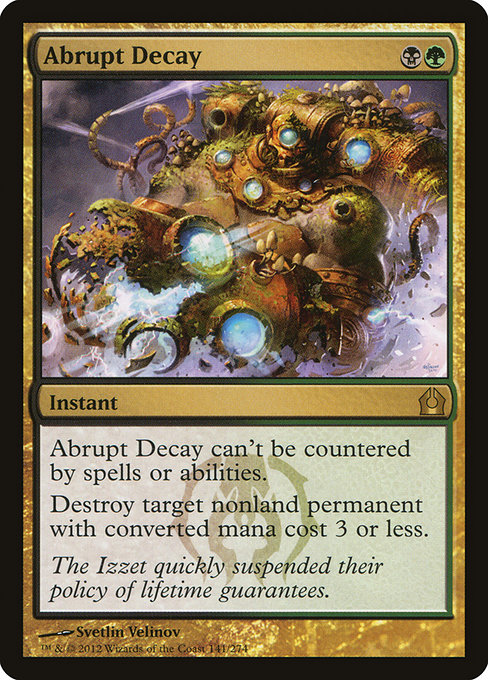


Destroy target nonland permanent with mana value 3 or less.
Abrupt Decay is powerful, but the important part is its shape: it answers a wide class of problems, it’s pulled into a specific guild, and it has a clear boundary (mana value 3 or less). That boundary creates real counterplay. Players can draft and build with it in mind instead of just hoping their threats dodge removal by luck.
When you’re tuning cube, “answer windows” like this are gold. They stop games from turning into “did you draw the one out,” while still letting larger threats matter.
FAQs
Is Return to Ravnica a good base for a set cube?
Yes, especially if you like two-color identity, board development, and games that reach a real midgame. The guild mechanics are clear, and the set has enough mana support to make gold playable without constant misery.
How do I keep an RTR-inspired cube from becoming 4–5 color goodstuff?
Start by favoring guild-specific fixing over rainbow fixing, and make sure your best payoffs are either (a) gold, or (b) color-intensive. If the strongest cards are easy to splash, players will splash them.
Which RTR mechanic is easiest to port into cube?
Overload-style “scales with mana” cards tend to work immediately because they’re good early and great late. Detain and Unleash also slot cleanly because they naturally support tempo and aggro shells.
Which RTR mechanic needs the most support?
Populate. If your cube does not make tokens consistently (and at useful sizes), Populate-style payoffs become traps. If you want that lane, commit to token production first.
If I’m printing an RTR-style cube as proxies, what matters most for draft-night feel?
Consistency and readability. Guild sets create busy board states, and you want rules text, mana symbols, and game objects to be easy to scan across the table. A consistent cut and finish also matters more than people expect once you shuffle a 360+ card pool all night.