
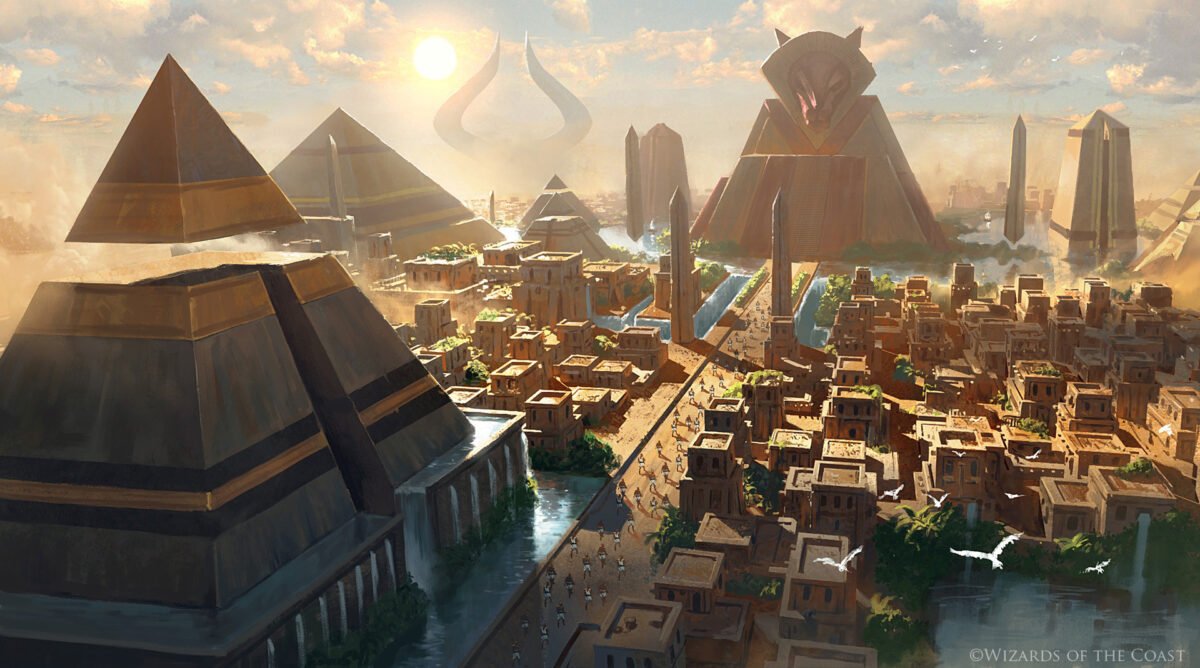
This post helps cube designers and Vorthos-minded drafters decide what parts of Amonkhet are “Ancient Egypt” versus “pop-culture Egypt” by mapping the real inspirations and the deliberate remixes, so you can build (or draft) a more intentional Amonkhet-flavored environment.
TLDR
- Amonkhet’s strongest “real history” wins are its animal-headed divinity vibe, royal naming symbolism, and afterlife-as-a-journey framing.
- Its biggest “fiction layer” is the Egyptomania toolkit: mummies-as-horror, curse aesthetics, and modern “tomb revenge” storytelling.
- Wizards explicitly designed Amonkhet as top-down Egypt plus top-down Bolas, with an intentional mismatch between shiny surface and grim mechanics.
- Aetherdrift’s return to Amonkhet adds new deities and a louder “Multiverse crossover” tone, which can feel cool or jarring depending on what you want your table to feel.
Ancient Egypt has been remixed by Western pop culture so many times that “Egypt-coded” can mean wildly different things. Sometimes it means gods and temples and cosmic order. Sometimes it means curses, mummies, and dusty tomb traps.
Amonkhet in MTG sits right on that fault line. It is absolutely Magic’s “Ancient Egypt plane,” but it’s also an intentionally artificial society built to serve Nicol Bolas. If you want to understand what the set is doing, it helps to separate Egypt-inspired religious iconography from Victorian-to-Hollywood Egyptomania and then notice where Wizards chooses one over the other.
What Amonkhet is trying to be
Amonkhet is not “historical Egypt with serial numbers filed off.” It’s a plane that uses Egypt as a visual and philosophical language, then twists that language to fit a story about control.
Wizards has been pretty direct about that creative target. The plane was conceived as top-down Egypt combined with top-down Bolas, and the team even tried to create “dissonance” by making the world look bright and aspirational while the gameplay feels harsher underneath. That’s a big part of why Amonkhet reads like a paradise with a trapdoor.
If you keep that in mind, a lot of choices click: the trials, the “worthy” ideology, the perfect city vs the hostile desert, and the way death is framed as both holy and industrial.
The biggest “Egypt” wins: gods, hybrids, and sacred-symbol logic
Egyptian art and religion are full of beings that combine human and animal forms, and Amonkhet leans into that in a way that feels more thoughtful than “slap a pyramid on it.”
Animal-headed divinity feels right (even when the details are MTG)
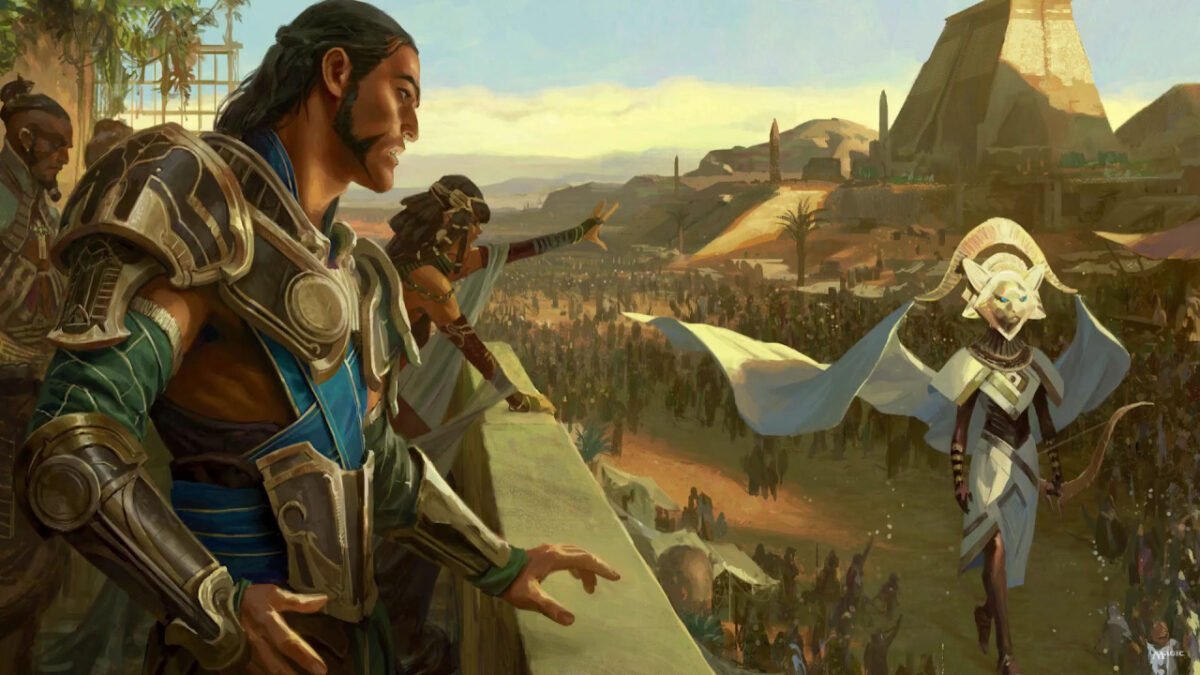
Amonkhet’s five major gods are a strong example of “this is not 1:1 history, but the shape of it is right.” They are explicitly animal-headed, walk among people, and represent moral virtues that structure society.
Here’s one iconic example:
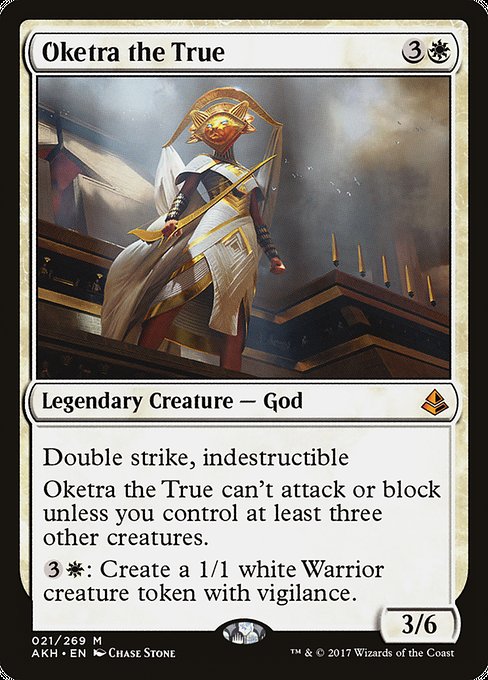

Oketra can't attack or block unless you control at least three other creatures.
: Create a 1/1 white Warrior creature token with vigilance.Even if you don’t map each god to a single Egyptian deity, the broader move is on point: Egyptian divinities are often expressed through animal aspects, and those aspects carry symbolic weight. Amonkhet’s gods do the same thing, just translated into Magic’s color pie and its “cycle of five” design instincts.
The “royal symbol” thinking is authentic in spirit
Where Amonkhet really nails it is not in any single reference, but in the way it treats names and symbols as power.
Ancient Egypt’s royal identity is famously layered: multiple names, multiple titles, each doing political and religious work. Amonkhet’s society is also built on layered identity, where public meaning, sacred meaning, and state meaning are the same thing.
That’s why Amonkhet’s best flavor reads less like “Egypt cosplay” and more like “Egypt-style symbolic logic.”
Cartouches: the nerdy deep cut that actually matters
If you only remember one “this is secretly clever” part of Amonkhet, make it the cartouches.
In real Egypt, a cartouche is an oval enclosure used for royal names, and it’s connected to the idea of protection (often explained through the shen ring). In Amonkhet, Cartouches are literal magical upgrades: you take on a name-mark, and you gain power. That’s a pretty elegant translation of “royal name as protected, charged symbol” into game mechanics.
It also points to a neat design lesson for cube builders: flavor can be structure. Amonkhet’s Cartouches aren’t just references, they’re a scaffold that connects the Trials, the gods, and the ideology of worthiness.
Where Amonkhet goes full Egyptomania (and why it’s a choice)
Now for the other side of the plane.
Amonkhet is also packed with the stuff modern audiences expect when you say “ancient Egypt,” even when that stuff has more to do with 19th–20th century fascination than ancient belief.
Mummies as horror
The real mummification tradition is complex, ritualized, and deeply tied to concepts of preservation and continuity. It also varied by time period and by wealth and status.
But pop culture tends to flatten mummies into “spooky undead with bandages.”
Amonkhet largely embraces the pop version because it needs a mechanical identity and a readable threat. Zombies and embalming are great Magic game pieces. It’s not “wrong,” but it’s a tonal choice that pushes the set toward horror-adjacent Egyptomania instead of leaning harder into spirits, judgment, and the afterlife as a continuing relationship with the living.
“Curses” and the Tut-myth gravity well
Modern “pharaoh’s curse” stories are a famous feedback loop: sensational reporting, coincidence, and a public that wanted the tomb discovery to feel supernatural.
Amonkhet’s curse aesthetics (including the way the plane treats doom and affliction as ambient) land inside that cultural gravity well. Again, not inherently bad, but it’s worth recognizing that “curse Egypt” is largely modern myth-making, not a clean window into ancient belief.
A quick “flavor dial” for Amonkhet-themed cube design
If you’re curating an Amonkhet-heavy environment, you can decide which version of “Egypt” you want to live in:
- Mythic Egypt: gods, trials, sacred symbolism, judgment, cosmic order, afterlife-journey vibes.
- Bolas Egypt: propaganda, perfection culture, “worthy” ideology, shiny surface hiding industrialized death.
- Egyptomania Egypt: mummies, curses, tomb dread, monster-of-the-week desert horror.
- Aetherdrift Egypt: Amonkhet as a living plane in the post-Omenpath multiverse, with new figures and crossover energy.
None of these are “the correct” Amonkhet. They’re just different mixes of what the plane already contains.
Real-world echoes: Cleopatra, Tut, and the devourer in the margins
Amonkhet also sprinkles in smaller nods that reward people who know the history.
- Hapatra reads like a wink toward Cleopatra in name shape and court intrigue vibes.
- Temmet feels like a Tutankhamun echo, especially in the “famous because the story around him got famous” sense.
- Ammit is one of the most satisfying pulls: a judgment-adjacent devourer figure that fits cleanly inside Amonkhet’s “worthy” ideology.
The important thing here is that Wizards isn’t trying to simulate a specific dynasty or time period. It’s building a resonance collage that players can read instantly.
Aetherdrift and “modernity intrusion”: why it feels different
Amonkhet’s original visits are tightly controlled: one city, one ideology, five gods, one planned afterlife.
Aetherdrift uses Amonkhet as part of a larger Multiverse event and explicitly tells us the plane has changed. We see:
- Surviving Bolas-era gods in a reduced, scarred state.
- New deities emerging.
- A louder sense that Amonkhet is one stop on a circuit, not a sealed bottle episode.
If you loved Amonkhet as “pure Egypt plane,” that tonal shift can feel like a scratch on the vinyl. If you like Amonkhet as “a plane that keeps surviving and remixing itself,” it’s pretty fun.
Amonkhet flavor elements, real-world anchors, and cube takeaways
| Amonkhet element | Real-world anchor | Cube takeaway |
|---|---|---|
| Animal-headed gods as virtue custodians | Egyptian divinity often expressed through animal aspects and symbolic roles | Use gods + trials as your “spine” if you want mythic cohesion |
| Cartouches as power-up emblems | Cartouches/shen ring tied to royal naming and protection | Cartouches are a perfect “build-around-lite” package for Amonkhet themes |
| Perfect city vs hostile desert | Egypt’s river life vs desert framing is iconic (and powerful in fiction) | Make the environment feel like “oasis safety” vs “wasteland threat” through card selection |
| Mummies/embalming as undead identity | Mummification is ritual preservation, varied by era and cost | Decide if you want mummies as horror, or pivot to spirits/judgment motifs |
| “Curse” aesthetics | Modern myth-making (Tut-mania, curse narratives), not a pure ancient belief | Use curse cards if you want Egyptomania, reduce if you want “mythic Egypt” tone |
| Post-return new deities and multiverse crossover | Modern MTG story evolution of the plane | If you want a “classic Amonkhet bottle,” keep Aetherdrift elements minimal |
FAQs
Is Amonkhet “accurate” to ancient Egypt?
It’s accurate in vibe mechanics more than in historical detail. The symbolic logic (animal-headed gods, sacred naming, afterlife framing) is strong, while the mummy-and-curse layer is more modern pop culture.
What’s a cartouche, and why is it such a good fit for MTG?
A cartouche is a royal-name enclosure tied to protection and identity. Amonkhet turns that into “name-mark grants power,” which is basically the cleanest possible translation of the real symbolic idea into game terms.
Are Amonkhet’s gods direct counterparts to Egyptian gods?
Sometimes you can draw parallels, but the better way to read them is as a Magic cycle: each god is built to express a color and a virtue, using Egypt-coded iconography rather than strict one-to-one equivalence.
Is the “pharaoh’s curse” an ancient Egyptian belief?
The famous “tomb curse” story is overwhelmingly modern. It grew from media sensationalism around Tutankhamun’s tomb and the deaths (and non-deaths) of people associated with the discovery.
If I’m building an Amonkhet-themed cube, what should I prioritize?
Pick your “flavor dial” first (mythic vs Bolas dystopia vs Egyptomania horror vs Aetherdrift crossover), then choose mechanics that reinforce it. Cartouches and Trials are the easiest glue, and consistent print/readability matters more than you think once the table is full of busy Amonkhet frames and desert-gold art.