
TLDR
- Start with what you already own. It’s faster, cheaper, and way less overwhelming than choosing from “all of Magic.”
- Pull two piles: fun cards (the ones you actually want to draft) and staples (removal, fixing, card draw, curve-fillers).
- Let themes emerge from your collection, then pick a cube size that matches your usual player count.
- Edit in passes: colors, curve, interaction, fixing (10–20%), then synergy density.
- Playtest ASAP and iterate in small swaps. Your first version is allowed to be messy.
This post helps cube-curious Magic players build an MTG cube from their existing collection by using a simple cards-first workflow, so you can start drafting quickly and iterate without spending months “designing.”
Why building from your collection is secretly the best constraint
Cube is Magic at maximum personality. You’re curating a limited environment that only exists because you made it.
That’s also why Cube can feel impossible to start. When you try to build from the entire history of Magic, you’re not designing a cube, you’re staring into the abyss and asking it to hand you a 360-card list.
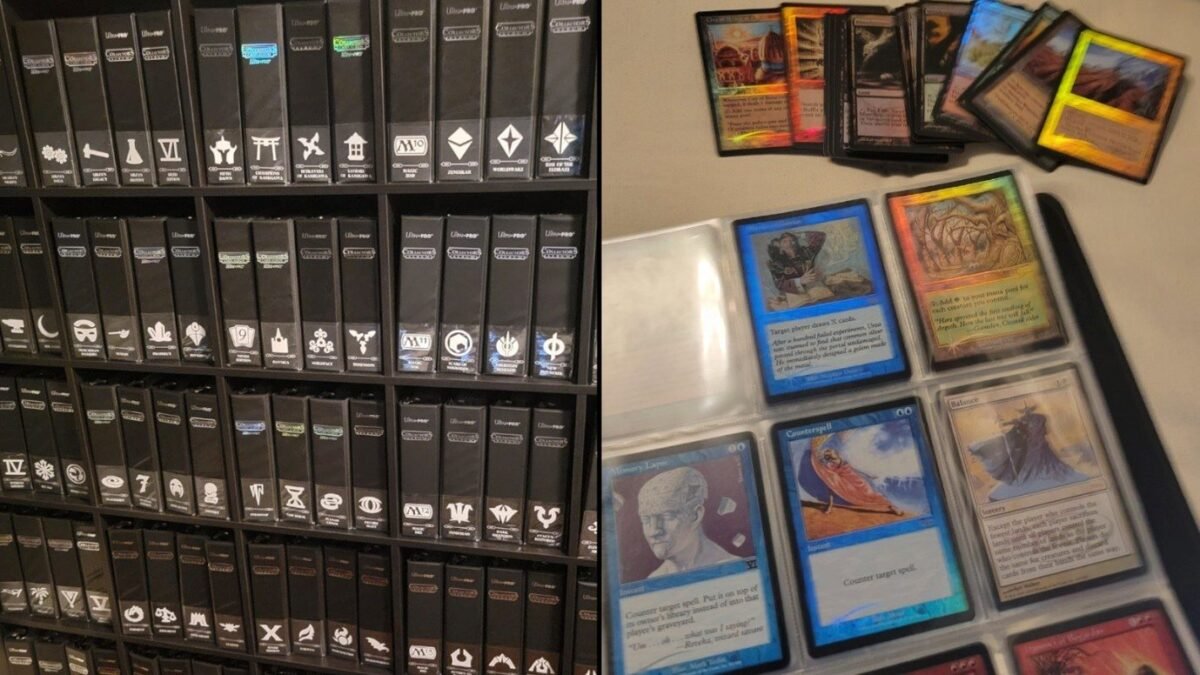
Your collection fixes that problem instantly. It narrows the choice space to something human-sized, and it does it in a way that’s personal. Your binder and boxes are a record of what you drafted, what you loved, what you built, and what you kept around “just because.”
Designing from your collection is not “Cube on hard mode.” It’s Cube on your mode.
The one downside: you’re exploring uncharted waters
A collection cube is uniquely yours, which is a blessing and a small headache.
You might run into practical holes (no good discard, no red burn, not enough fixing, one color is twice as deep as the others). Those are usually solvable with a small set of targeted additions.
The trickier part is feedback. If your card pool is idiosyncratic, generic “cube staples” advice won’t always apply cleanly. That’s fine. Your goal isn’t to build The Correct Cube. Your goal is to build a cube your group wants to draft again next week.
Build a collection cube in 4 steps
Step 1: Pull cards first, judge later
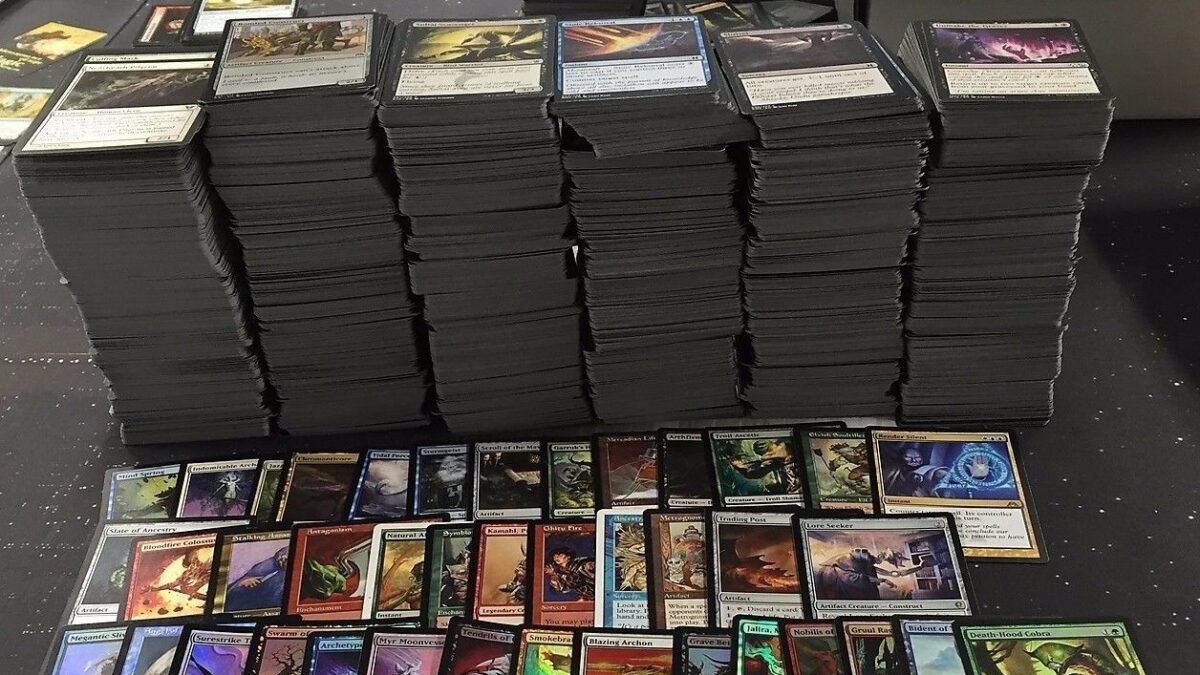
Grab a big empty table (or the floor, no shame) and start pulling cards that feel like “yes, I want to draft this.”
At the same time, pull the boring glue that makes drafts function. This is the stuff nobody gets excited about until it’s missing:
- cheap removal
- card draw / card selection
- mana fixing
- early creatures so aggressive decks exist
- a few sweepers and catch-all answers so games don’t snowball uncontested
If you want one practical rule here: don’t try to balance anything yet. You’re gathering raw material, not building the final list.
If your fixing section is thin, even something like this does real work early on:

 , Sacrifice this land: Search your library for a basic land card, put it onto the battlefield tapped, then shuffle.
—High Evolutionary, Herbert Wyndham
Step 2: Find patterns, then choose a size that matches your nights
Once you’ve got a stack, look for what it’s already trying to be.
Ask yourself:
- What are the cards I want to be “the point” of this cube?
- What mechanics or themes keep showing up naturally?
- What decks do I hope people can draft?
- What’s missing (effects, colors, card types, mana values)?
Then pick a rough cube size. If you’re new, smaller is your friend because it makes testing and editing faster.
Here’s a simple starter template that’s “good enough” for early drafts:
| Cube size | Typical “classic draft” use | Cards drafted (3×15) | Fixing target (10–20%) | Why this size is great from a collection |
|---|---|---|---|---|
| 180 | 4 players | 180 | 18–36 | Fastest to build, easiest to iterate, perfect for small groups |
| 360 | 8 players | 360 | 36–72 | The classic cube night baseline; archetypes show up reliably |
| 540 | 8 players (more variety) | 360 drafted / 540 total | 54–108 | More novelty, more room for pet cards, more “different draft every time” energy |
A note that saves pain later: fixing is the first thing your collection cube will be short on, and it’s the first thing your players will feel when it’s missing. You do not need premium lands to start, but you do need enough fixing that people can cast spells.
Step 3: Edit in passes (so you don’t spiral)
Editing a cube is emotionally harder than building one, because cutting cards feels like rejecting them. The fix is to edit in passes and keep a “maybe” pile.
Pass A: Make the colors roughly even.
You’re not chasing perfection. You’re preventing “blue has 90 cards and red has 35.”
Pass B: Check the curve and roles.
Make sure each color can plausibly draft:
- an aggressive start
- a midrange plan
- interaction that matters
If one color only has 5 two-drops, that’s not a vibe. That’s a warning.
Pass C: Make your themes actually draftable.
If you have a payoff, you need enough enablers that a drafter can realistically assemble the deck in a real draft. A good gut-check is: “If one player is the only person in this lane, can they still miss the deck?” If the answer is yes, add more overlap pieces or trim the payoff.
Pass D: Set your power band using benchmark cards.
Pick a handful of cards that represent the experience you want. Then look for outliers:
- cards so weak they never make maindecks
- cards so strong they erase the rest of the environment
Cube doesn’t need to be flat. It does need to be fun. Outliers usually aren’t.
Step 4: Playtest immediately, then iterate small and often
Your cube can contain your favorite cards and still produce gameplay you don’t enjoy. The only way to find out is to draft it.
Here’s a simple draft-night checklist that makes iteration painless:
- Pull the right number of cards for your player count and draft format (example: 4 players = 180 cards for 3×15)
- Track “last picks” and cards that never make maindecks
- Note any consistent non-games (color screw, flood, can’t interact, one deck always runs over the table)
- Watch for archetypes that look supported but never come together
- After the night, swap 5–15 cards, not 50
- Keep your cuts in a “maybe” box so nothing feels permanent
Small changes teach you faster. Big overhauls just reset the experiment.
Patching common holes without turning it into a shopping spree
Most collection cubes hit the same gaps early:
- not enough fixing
- not enough cheap interaction
- too many narrow build-arounds with not enough support
- one color (often blue) is dramatically deeper than the others
My favorite solution is the “patch list”: a small allowance of additions (buy or print) whose job is only to make drafts function. You’re not “upgrading” the cube. You’re preventing it from failing in predictable ways.
If you’re using printed play pieces for your cube, consistency matters more than perfection. Clear text, consistent sizing, and a uniform feel across the whole list makes draft decisions easier and gameplay smoother (especially once everything is sleeved).
Digitize when you’re ready, not when you feel guilty
You don’t need a website to build a cube. But once you’re iterating, digitizing saves you from forgetting what changed and why.
A good workflow is:
- keep the cube physical for early drafts
- digitize once you’re past “random pile of fun cards” and into “intentional list”
- update the list right after you make swaps, while the changes are still fresh
Even a messy first draft list is worth entering. Future-you will thank you.
FAQs
How many cards do I need to start a cube from my collection?
If you have 2–4 players most of the time, start at 180. If you regularly hit 6–8 players, aim for 360. Bigger cubes are fun, but they make early iteration slower.
What if my collection is lopsided in one color?
That’s normal. Start by balancing with role-players (removal, curve creatures, generic interaction) and don’t be afraid to run fewer gold cards until the base colors feel stable.
Do I need expensive lands for a collection cube to be fun?
No. You need enough fixing, not necessarily “the best” fixing. Tapped lands are playable, especially in lower-power environments. Just make sure people can cast their spells.
How do I stop synergy decks from whiffing?
Treat every synergy payoff like a promise you’re making to a drafter. If you can’t support it with enough enablers (plus a few extras for variance), cut the payoff or replace it with overlap cards that help multiple decks.
Should I add cards beyond my collection?
Yes, but do it after you’ve drafted at least a couple times. Playtesting tells you what you actually need, and it prevents you from buying (or printing) 80 cards that don’t solve the real problems.