
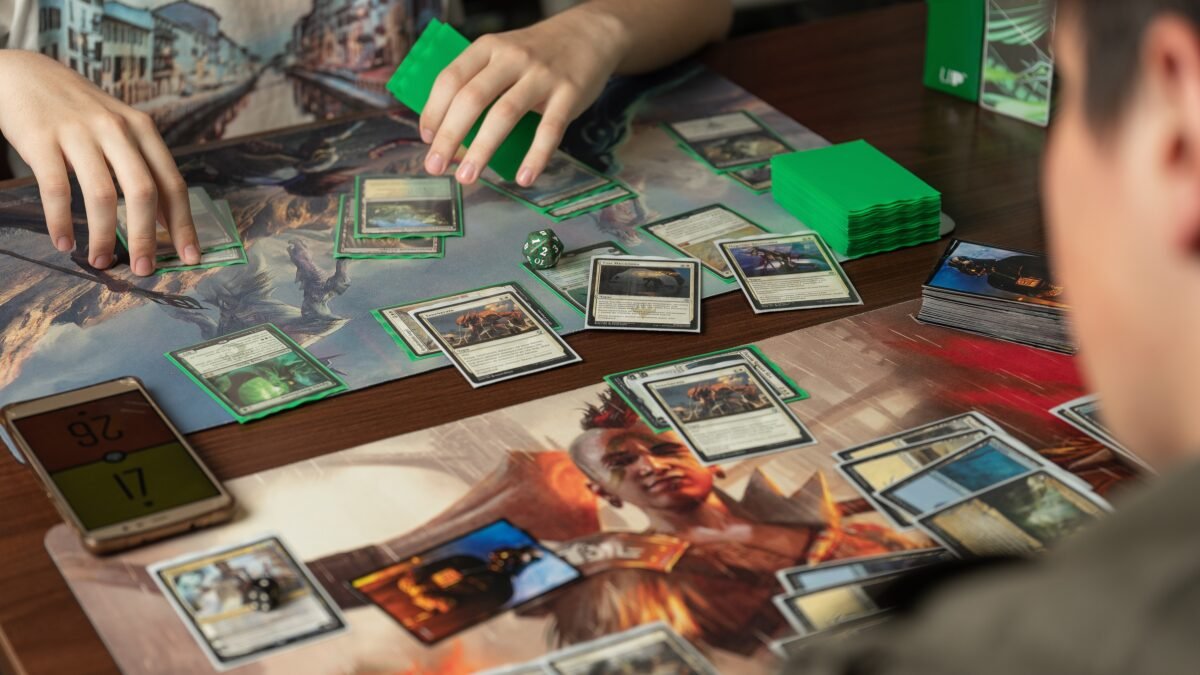
This post helps cube-minded Magic players build and play a Battle Box MTG setup by explaining the baseline rules, the land “station,” and the biggest list-building tradeoffs, so they can keep a self-contained format ready for quick, great games anywhere.
TLDR
- Battle Box MTG (also called Danger Room) is “spells only” Magic with a shared deck and a fixed land set you play from each turn, so you skip mana screw and flood.
- The common baseline is 4-card opening hands, no mulligans, and 10 preset lands per player (five basics plus five tapped dual lands).
- Building a good box is mostly about flat power, lots of interactive cards, and a lower curve than you think (because everyone hits land drops).
- Avoid or carefully handle effects that tutor, shuffle, ramp, or destroy lands, because they fight the format’s “fixed resources” goal.
- Treat it like a micro-cube that you play immediately: tune for tempo, combat, and decision density, not for drafted archetypes.
Battle Box MTG is one of the cleanest ways to get “real Magic” in 15 minutes. You grab a friend, grab the box, and you are playing. No deckbuilding, no drafting, no rummaging for basics mid-game.
The whole point is that Battle Box removes the resource variance that creates a lot of non-games. When both players always have access to lands and always draw spells, the format puts the spotlight on sequencing, combat math, and the kind of strange card interactions that usually get buried under mana issues.
What Battle Box MTG is (and why people keep it in their bag)
A Battle Box is a curated stack of nonland spells that both players draw from. Instead of drawing lands, each player has a small preset “land station” outside the game. Each turn, you choose which land to play from that station, one land per turn, normal land drop rules.
This creates a very specific feel:
- Your draws are always action.
- Your mana is “fair,” but still skill-testing. You still have to plan your colors.
- Board states get dense. You do not run out of stuff to do unless your list is extremely low-powered.
You will also hear “Battle Box” used in a different way sometimes, meaning a collection of prebuilt decks. In cube circles, “Battle Box MTG” usually means the shared-deck, fixed-lands format (the “Danger Room” style).
How to play Battle Box
Here’s a solid baseline that matches how most modern Battle Boxes are described and played. Treat it as your default, then tweak once you have ten games under your belt.
Setup
- Make one shared deck of spells (no lands) and shuffle it.
- Each player gets the same 10-land station set aside from the game.
- Decide who goes first. Start at 20 life unless your box is tuned for something else.
Land station (classic 10)
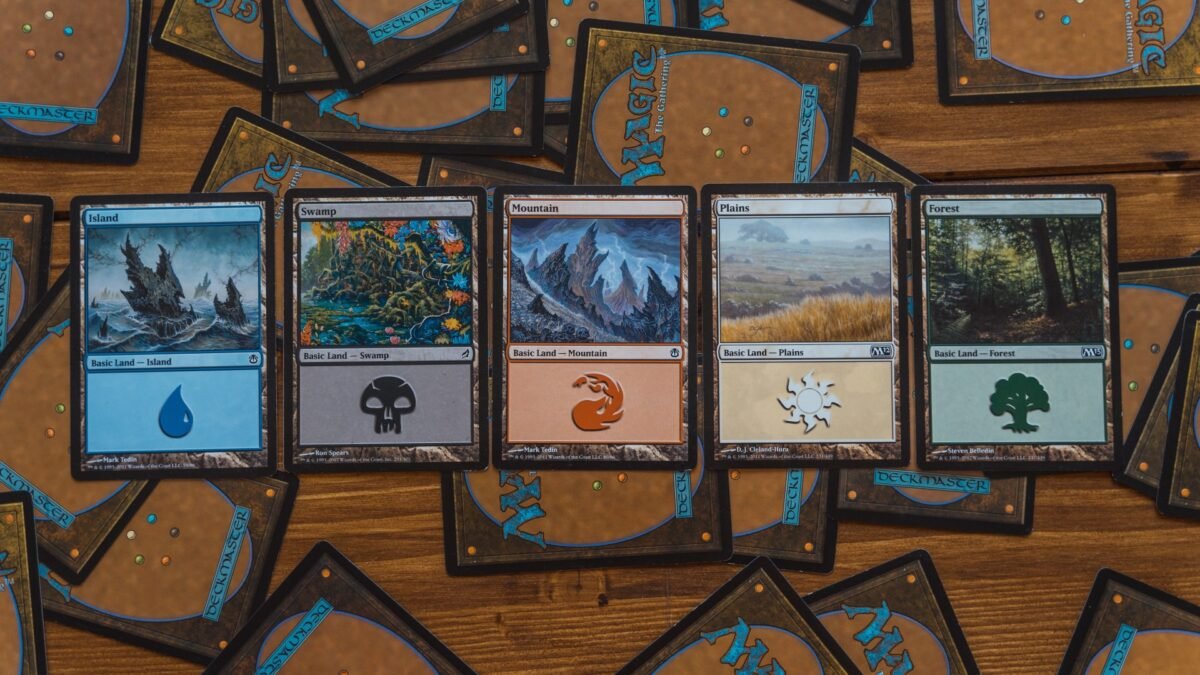
A very common land package is:
- 1 of each basic land (Plains, Island, Swamp, Mountain, Forest)
- 5 tapped duals (often the allied Invasion duals)
Example duals people use a lot:
- Coastal Tower (W/U)
- Salt Marsh (U/B)
- Urborg Volcano (B/R)
- Shivan Oasis (R/G)
- Elfhame Palace (G/W)
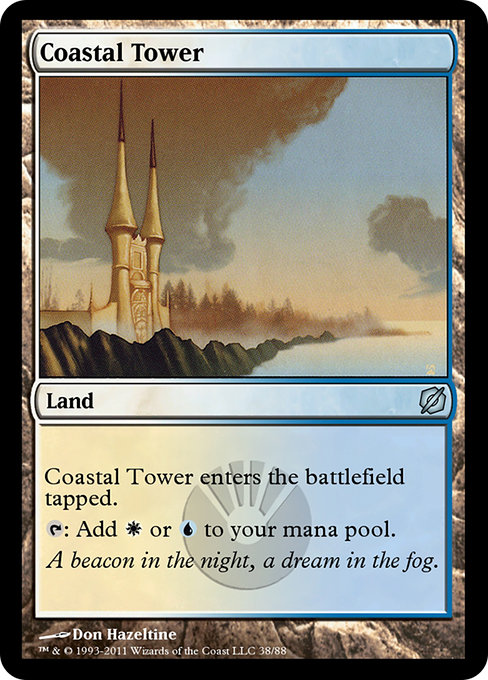
 : Add
: Add  or
or  .
.Gameplay rules (baseline)
- Each player draws an opening hand of 4 cards.
- No mulligans. (Hands are hard to evaluate and you always have mana, so the usual mulligan incentives get strange.)
- On each of your turns, you:
- draw one card from the shared spell deck
- may play one land from your land station
- otherwise play a normal game of Magic
A small rule that prevents arguments
Because you are drawing from a shared deck, you need a clean ownership convention. The simplest and most common approach is:
- You “own” the cards you draw.
If you cast a creature and your opponent bounces it, it goes back to your hand. If your creature dies, it goes to your graveyard.
That one convention keeps things intuitive and makes most corner cases disappear.
The biggest design knob: shared deck vs split decks
Most Battle Boxes use a single shared library because it is fast and it feels unique. But there is a real cost: cards that manipulate the top of the library play differently when both players share it.
You have three viable approaches:
- Shared library, embrace the weirdness. Scry can become a tactical weapon. Milling can be interactive in new ways. This is novel and fun if your group likes that kind of play.
- Shared library, minimize top-deck manipulation. You keep the “mystery draw” vibe and avoid most of the unintuitive moments.
- Split the stack into two decks each game. This makes scry and similar effects feel more “normal,” but adds setup time and changes the vibe. It also reduces the “we are both at the mercy of the box” feeling.
There is no “correct” choice. Pick the one that matches why you are building the box in the first place.
Battle Box list-building: the principles that matter most
Battle Box is cube-adjacent, but you are not drafting. That changes what “good design” means.
1) Flat power matters more than peak power
If one or two cards are miles above the rest, Battle Box games start to feel like “who drew the outlier.” Most designers aim for a tight band where almost every draw is playable and very few draws are game-ending on their own.
A useful mental model is “high-quality Limited” rather than “Constructed bombs.” If you want a card to be a haymaker, make sure the box has enough answers and tempo plays that the haymaker does not end the game on the spot.
2) Keep a roughly even color distribution
You can skew colors, but you give up a lot if you do:
- sequencing lands becomes less interesting
- experienced pilots get a bigger advantage (they know what colors are “safe”)
- some lands become secretly better if your spell colors are uneven
If your goal is “pick-up-and-play,” balance by color is one of the easiest wins.
3) Respect the “ten lands, three sources” reality
With the classic 10-land station, players typically cap out at three sources of any one color across the whole game. That has two important effects:
- Triple-pip cards (like
 ) are much harder to cast on curve.
 - Two-pip cards are still fine, but they create real sequencing tension.
If you love that tension, keep it. If you hate nonfunctional hands caused by devotion costs, bias your list toward lighter color requirements and more hybrid, kicker, cycling, and modal spells.
4) Build lower on the curve than your instincts say
Because everyone hits land drops, expensive spells get a big boost. In regular Magic, six drops are balanced around the fact you often will not hit your sixth land on turn six. In Battle Box, you will.
That means you can accidentally create a box where:
- the first five turns are “setup,”
- then someone starts slamming five and six drops every turn,
- and your cheaper interaction cannot keep up.
A simple fix is to bias toward:
- impactful two and three drops
- cheap interaction that trades well
- threats that scale rather than just “bigger stats”
Here’s a practical curve target you can start from.
| Mana Value | Target count (180-card box) | Why it works in Battle Box |
|---|---|---|
| 1 | 18 | Early plays matter more with small opening hands. Keep these interactive, not just filler. |
| 2 | 45 | The “engine room” of the format. Most games should hinge on two-drops trading and sequencing. |
| 3 | 54 | Where you want the most variety: ETB value, tempo plays, flexible removal, buildable threats. |
| 4 | 36 | Strong, but do not let four-drops be your whole identity. Too many makes games snowball. |
| 5 | 18 | Your top-end needs answers and comeback tools. Keep finishers strong, not unstoppable. |
| 6+ | 9 | A little spice is great. Too much makes the format feel like “who drew the dragon first.” |
Treat those numbers as a starting point, not a law. If your power band is lower, you can afford a slightly higher curve. If your power band is higher, you usually want to go lower to keep tempo real.
5) Prioritize flexible cards over narrow “archetype cards”
Because players are not drafting, they cannot intentionally assemble synergy packages. A narrow build-around might still be fun, but it will be inconsistent unless you build the entire box to support it.
Flexible cards have two big advantages in Battle Box:
- they are good on turn two and on turn nine
- they help players form a plan from whatever they drew, instead of punishing them for not drawing “the rest of the deck”
A poster child for “flexible, always has play” is a card like this:
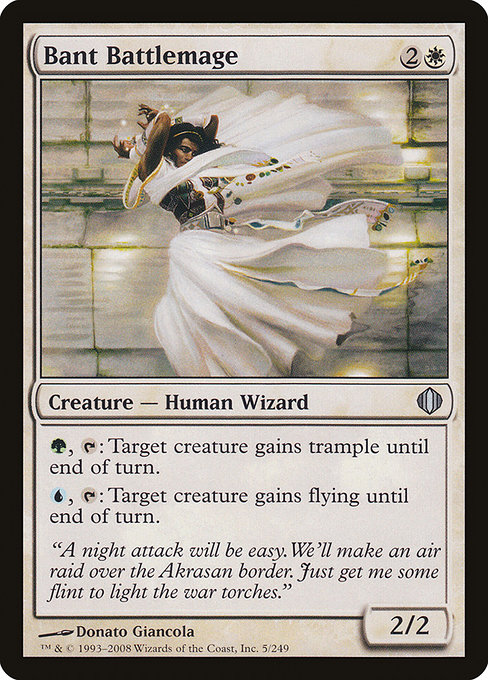
 , : Target creature gains trample until end of turn., : Target creature gains flying until end of turn.
Even when you cannot cast it on curve, it is rarely dead, and it rewards planning your land drops without demanding a whole archetype.
What to avoid (or use very carefully)
Battle Box works because resources are predictable. The easiest way to break the format is to reintroduce resource variance through the back door.
Here are the usual suspects:
- Tutors and deep searching. They slow the game down, increase decision fatigue, and can turn a “quick match” into a long browse through a 200-card stack.
- Shuffling effects. They are time-consuming in a large shared deck and create awkward questions about who controls the library.
- Mana acceleration. If one player starts jumping ahead on mana, you undo the format’s core promise. Even small ramp creatures can distort the environment.
- Land destruction. Same reason as ramp. “Fixed lands” is the point, so keep it fixed.
- Overbearing snowball threats. Some cards are “fair” in regular Magic because you might not cast them on curve. In Battle Box, they show up early and often enough to become problems.
This is also where you decide whether to include planeswalkers. Many Battle Box designers skip them because they tend to warp combat and snowball, especially with guaranteed land drops.
Card advantage is different here, and it changes everything
Battle Box has a subtle built-in card advantage: you draw a card every turn, and you also get to “play a land” from outside the game. Over time, that means players effectively see more action than in a normal game.
That makes traditional “draw two cards” spells much stronger than they look.
If you want games to stay about board states and tempo, try this approach:
- Limit pure card draw.
- Use more card selection (looting, cycling, impulse draw, modal spells).
- Put card advantage onto interactive bodies and effects, so it costs tempo to gain value.
If you like the grind, you can absolutely include real draw spells. Just be aware that they are one of the fastest ways to create a “value gap” that is hard to come back from in a fixed-mana environment.
The land station is part of the game, not just a workaround
One of the best parts of Battle Box is that land sequencing becomes a mini-game.
With the classic 10 lands, you are constantly asking:
- “Do I need untapped mana now, or perfect colors later?”
- “Can I afford to play a tapped dual this turn?”
- “What colors am I committing to if I play this land?”
If you want more color freedom, you can swap the tapped duals for other cycles (Guildgates are a common budget option). If you want less freedom and more tension, keep the land station restrictive.
A good rule is: change the land station only if you are intentionally changing the play experience.
Logistics that make Battle Box feel effortless
Battle Box succeeds when it is actually easy to pull out and play. That means your physical setup matters.
A clean, practical setup:
- One sleeved spell deck
- Two (or more) sleeved land stations
- A small token bundle (or reduce token-makers in the list)
- Dice, a life method, and maybe a few reminder counters
Sleeving the land stations in a different color from the spell deck helps avoid mixing mistakes and speeds up cleanup.
If you like to travel with your box, cube travel logic applies almost perfectly. The same “separate compartments, prevent sliding, keep a grab-and-go kit” advice that makes cube night smoother also makes Battle Box feel like a real pocket format. This PrintACube post is directly relevant: How to Store and Transport an MTG Cube: Boxes, Sorting, and Travel Setups.
And if you are building your Battle Box like a cube (singleton, curated, tuned), the same thinking behind “why singleton is the default” applies here too: Are MTG Cubes Singleton? Why Cube Uses Singleton.
A quick Battle Box build checklist
If you want a fast path from “pile of cards” to “this plays great,” use this checklist after your first few sessions:
- Do games end because of decisions, or because someone drew the one busted card? If it is the second, flatten your power band.
- Are there enough cheap plays? If hands clog, cut some five-plus drops and add two and three drops.
- Do players have meaningful interaction most turns? If not, increase removal, bounce, and combat tricks slightly.
- Do colors feel usable? If one color is regularly stranded, check pip intensity and your color balance.
- Does the land station create fun tension, or random punishment? Tune your spell costs or change the land package.
- Do card draw spells create runaway games? Replace some with looting, cycling, or value creatures.
- Is shuffling slowing things down? Cut shuffle effects, or house-rule them into “put on bottom” style simplifications.
- Does cleanup feel annoying? Reduce token variety, separate sleeves, and keep components in compartments.
Variations worth trying (once your baseline is stable)
Once your default box plays well, variations are where Battle Box becomes a design playground.
1) Theme boxes
Instead of supporting many archetypes, you tune around one or two themes. The upside is higher synergy. The downside is that every game feels closer to a mirror match.
2) Multiplayer Battle Box
Totally doable. It often benefits from:
- slightly higher starting life
- a bit more board control (sweepers, defensive tools)
- clear rules for card ownership and graveyards
3) “Any card can be a land” Battle Box
Some groups remove the land station entirely and let players play a card face down as a land, or exile a card to play a land from outside the game. This adds a lot of choices and reduces the “wrong colors” moments, but it also adds complexity because every card becomes modal.
4) Shared graveyard
Some versions share a graveyard as well as a library, which creates a very different recursion and hate landscape. It is fun, but it increases rules conversations, so it is best for groups that enjoy that.
FAQs
Is Battle Box MTG good for teaching new players?
It can be, because you remove deckbuilding and mana-base mistakes. But the gameplay can still be skill-intensive, since both players usually have multiple reasonable lines every turn. If you are teaching, tune the box slightly lower-power and keep rules text complexity in check.
How many cards should a Battle Box be?
Most Battle Boxes land somewhere around 100 to 200 cards, but there are popular “big stack” versions that go far larger. Bigger means more variety, but less portability and more mental load when players are unfamiliar with the list.
A simple rule of thumb: if you want a Battle Box that feels fresh over many sessions, start around 150 to 200 spells, then expand only if you enjoy the upkeep.
Do I really need no mulligans?
You do not need it, but “no mulligans” is a clean rule that keeps games quick and avoids the weird incentives created by always having lands. If your games have too many nonfunctional starts, fix the list first (curve, pip intensity, interaction) before adding mulligans back in.
Should I include planeswalkers?
It depends on your power band and how you want games to feel. Many Battle Box designers skip planeswalkers because they can snowball and pull games toward “answer this immediately” patterns. If you do include them, keep them to the more interactive, board-dependent walkers and make sure you have enough clean answers.
What sleeves and storage work best for a Battle Box?
The boring answer is the correct one: consistent sleeves, consistent card size, and a box that keeps things from sliding. Separate the spell stack and land stations physically so setup is fast and cleanup is brainless.
Build your Battle Box
Battle Box is not “fixing Magic.” Mana variance is part of what makes normal Magic dramatic. What Battle Box does is highlight a different slice of the game, the part where every turn is a decision and every draw is a spell.
If you like cube for the curation and the replayability, Battle Box MTG is the version you can play between rounds, at a kitchen table, or in a bar with one friend and ten minutes. Start with the baseline rules, keep your power band flat, bias low on the curve, and tune after real games. The format will meet you halfway.