

This post helps MTG cube owners sort multicolor cards in a way that keeps drafts clean, updates painless, and “gold traps” under control, without letting bookkeeping rules bully your card choices.
TLDR
- Decide what sorting is for: draft signals, cube balance math, or just faster cleanup.
- Treat gold (needs both colors) and hybrid (can be either color) as different animals, because they play differently.
- For “gray area” cards (flashback, kicker, activations, land-type matters), file them where they actually get played, then optionally “weight” them for color-balance math.
- If you feel forced into bad gold to “keep sections even,” your sorting system is the problem, not your cube.
- Big cube? Consider a rotating “bonus gold” module instead of bloating every draft with narrow multicolor picks.
Why sorting multicolor cards turns into a fight
Cube designers argue about multicolor sorting because it looks like a design decision, but most of the time it’s a bookkeeping problem.
Your cube’s gameplay is shaped by:
- how often drafters see castable playables,
- how strong your fixing is,
- how many picks in each pack are “real” choices versus dead-end commitments.
Where you write down a card in a list does not change the cardboard. But it does change how you:
- evaluate color balance,
- decide what gets cut,
- accidentally talk yourself into “perfect symmetry” that makes your cube worse.
So the goal is not “the one true filing system.” The goal is: a sorting system that helps you build the cube you want, instead of constraining you.
How to sort multicolor cards: pick your goal first
When people say “How do you sort multicolor cards?”, they usually mean one of these three questions:
- Draft clarity goal (signals)
- You want packs to communicate lanes cleanly.
- You want fewer picks that look exciting but lead to trainwreck mana.
- Balance and maintenance goal (counts and ratios)
- You want your list tool, spreadsheet, or cube blog post to reflect reality.
- You want to notice when one color is quietly getting “extra cards” via hybrid, flashback, or activation lands.
- Physical cleanup goal (post-draft sorting)
- You want your group to sort quickly into piles that make sense.
- You want to find cards fast when you update the cube.
You can satisfy all three, but it helps to name which one you care about most. My default recommendation is:
Draft clarity first, maintenance second, cleanup third.
Because draft signals affect everyone at the table. Spreadsheet aesthetics mostly affect you.
Gold vs hybrid: treat them like different species
The core mistake in multicolor sorting is treating hybrid as if it behaves like gold.
Gold cards are “AND”
A classic gold card asks for both colors to be reliably cast on time. Even if it has just one pip of each color, it still pulls a drafter into a two-color commitment.
Gold cards are great when:
- your fixing supports them,
- they reward a lane that needs a payoff,
- they are worth the risk.
Gold cards are bad when:
- they show up too often,
- they tempt drafters into early commitments your fixing cannot support,
- they become sideboard glue.

Hybrid cards are “OR”
Hybrid was literally designed to explore “not and but or.” In cube terms: hybrid cards usually function like shared monocolor cards that either of two decks can play.
That’s why hybrid gets punished by strict “guild slot” systems. A card that either color can play competes against cards that only one exact color pair can play, and the hybrid loses on paper even when it improves drafts in practice.
Here’s a representative hybrid card that illustrates the point:
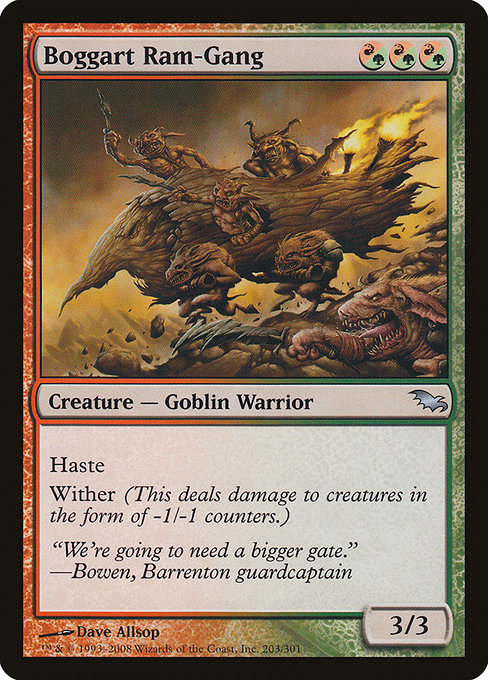
 /
/ //
//Wither (This deals damage to creatures in the form of -1/-1 counters.)
—Bowen, Barrenton guardcaptain
In many environments, Boggart Ram-Gang plays like:
- a red aggro 3-drop,
- or a green stompy 3-drop,
- or an RG aggro curve piece.
It is not the same kind of commitment as a gold-only RG card that requires both colors.
The practical takeaway
If your current system makes you say “I can’t run this hybrid because Boros already has 3 cards,” your system is probably lying to you.
The gray area checklist
Not every multicolor-ish card fits neatly into gold/hybrid. Here’s a checklist that handles most of the “but what about…” cases.
Step 1: Ask the only question that matters
Would I happily play this card in a deck that cannot use the off-color part?
- If no: treat it like multicolor (gold-ish).
- If yes: treat it like monocolor (or hybrid-ish), and tag it for the off-color upside.
This single question solves most debates about:
- off-color flashback,
- kicker,
- activated abilities,
- land-type matters.
Step 2: Decide where it lives (filing)
Pick one “home” for the card that makes updates and searches easy.
Common homes:
- Guild section (Azorius, Rakdos, etc.)
- Mono-color section (White, Blue, etc.)
- Hybrid section (optional, if you like this middle bucket)
- Lands section (even if the activation is multicolor)
- Colorless section (if it’s truly universal)
Step 3: Optional: assign a “weight” for balance math
If you like tracking color representation without forcing symmetry, assign fractional weights.
Simple default weights:
- Gold (two-color): 0.5 + 0.5
- Hybrid: start at 0.5 + 0.5, then bias if it mostly plays like one color
- Mono card with meaningful off-color flashback/kicker: 0.75 main + 0.25 off (or 0.8/0.2)
You do not need perfect math. You need math that catches obvious drift.
A simple bookkeeping system that avoids “guild slot prison”
If you want something you can actually maintain, use two labels per card:
Label A: Filing label (where it goes in your list and box)
This is for:
- physical sorting,
- quick searches,
- “what section do I cut from?”
Label B: Play label (how decks actually use it)
This is for:
- balance math,
- archetype support analysis,
- understanding draft signals.
In practice, Label B can be a tag like:
- “Plays like mono-W”
- “Splash B often”
- “Only good in BG”
- “Hybrid-flex”
- “Fixing payoff”
This is also where list tooling matters. A lot of sites and datasets treat hybrid as “both colors” because rules-wise it is both colors, even if gameplay-wise it behaves like “either.” If your tooling insists on rules-based color identity, your tags are how you re-inject reality.
Quick table for common edge cases
Use this table as a default. Then deviate when your cube’s fixing, speed, and archetypes demand it.
| Card type | Example kind of card | File under | Weight for balance math | Why |
|---|---|---|---|---|
| Two-color gold spell | “Real” gold creature/spell | Guild | 0.5 / 0.5 | Needs both colors to cast consistently |
| Hybrid spell | Two-color hybrid or monohybrid | Mono or Hybrid section | 0.5 / 0.5 (or 0.7 / 0.3) | Often plays like shared mono-color support |
| Off-color flashback (often used) | Flashback is a real part of the card | Guild | 0.5 / 0.5 (or 0.6 / 0.4) | If you’re rarely flashing back, it’s probably mis-filed |
| Off-color flashback (rarely used) | Flashback is “bonus mode” | Main color | 0.8 / 0.2 | Keeps it from eating a gold slot while still counting the drift |
| Kicker that is basically required | “Unplayable without kicker” cases | Guild | 0.5 / 0.5 | Decks that can’t kick it don’t really want it |
| Land with multicolor activation | Utility land that rewards a pair | Lands | 0.5 / 0.5 (optional) | It’s drafted and stored as a land, but it still rewards a color pair |
| Land-type matters one-drop | Castable in one color, demands support | Main color | 1.0 main + tag | Draftable early without forcing a guild commitment |
| Three-color bomb | Shard/wedge finisher | 3-color section | 0.33 / 0.33 / 0.33 (optional) | High bar, but if it’s in, it’s in |
If you only adopt one thing from this article, adopt this:
File for clarity. Weight for math.
How many gold cards per guild should I run?
This is the part where sorting and design actually touch.
If you run too many gold cards:
- packs contain more narrow picks,
- drafters get baited into commitments,
- your table complains that “fixing sucks” even when fixing is fine,
- you get more sideboard cards and fewer meaningful decisions.
A practical rule of thumb for a typical 360–540 cube is:
- keep multicolor as a small slice of the overall environment,
- and raise or lower that slice based on fixing quality and desired greed.
If you want a “clean” two-color leaning cube, treat gold cards as a high bar rewards section, not a big feature.
If you want a higher-greed environment, you can run more multicolor, but you pay for it with:
- more fixing density,
- faster fixing (more untapped),
- fewer punishing pip costs elsewhere.
When a rotating gold module is worth it
If you have a big cube and you love gold cards, there’s a real problem:
- You want variety (more sweet multicolor cards).
- You do not want drafts full of narrow picks.
A rotating module solves that by keeping:
- variety high across drafts
- density controlled within a draft
How it looks in practice:
- You keep a “core” cube that always drafts.
- You keep a separate multicolor module.
- Each draft, you shuffle in a subset of that module.
Tradeoffs:
- Pros: more novelty, fewer repetitive “same ten gold cards” drafts, less early commitment bait.
- Cons: slightly more setup and teardown, and some archetype support cards become less reliable if they live in the rotating module.
If your table already sorts post-draft into piles, adding “one more pile” is usually not a big deal.
Physical sorting tips for draft night
If your main pain is cleanup and storage, keep it boring:
- Draft-night sorting piles: W / U / B / R / G / Multicolor / Colorless / Lands
- Update sorting piles: W / U / B / R / G / Guilds / Hybrid (optional) / Colorless / Lands
And if you print proxies for your cube, prioritize what makes sorting and play smoother:
- consistent sizing and cuts (so shuffling feels normal),
- consistent symbol clarity (so drafters don’t squint at hybrid pips),
- consistent versions (so the same card always looks the same at a glance).
That’s the kind of printing detail that actually affects gameplay and table speed.
FAQs
Should hybrid cards take up guild slots?
Usually, no. Hybrid cards often play like shared monocolor support, so treating them as “guild quota” cards tends to reduce draft flexibility and punish good includes.
Where should I put off-color flashback cards?
Use the “would I play it without the flashback?” test. If the off-color half is central to why it’s in the cube, file it as multicolor. If it’s mostly bonus value, file it as the main color and tag it as a splash card.
Where do I put lands with multicolor activations?
Physically and in your list, lands are easiest to maintain in the lands section. If you do color-balance math, you can still “weight” them toward the colors they reward.
Do I need perfect balance in my multicolor section?
No, and chasing it can make your cube worse if it forces includes you don’t actually want people to draft and play. Balance is useful as a diagnostic, not as a law.
What about three-color cards?
Run them only if your fixing and environment make them realistic, and hold them to a very high standard. They’re inherently narrower, so each one you include should create real excitement, not just take up space.