

This post helps cube designers decide which Battle for Baldur’s Gate cube cards are worth testing by summarizing community survey data and turning it into a simple, practical test plan.
TLDR
- A cube survey of 164 responses from 144 curators suggests CLB landed as “moderate excitement,” roughly in the same neighborhood as sets like AFR and Crimson Vow.
- The most-tested cards mix raw power (Minsc & Boo) with archetype glue (Gut, Noble’s Purse) and a few mechanics packages (Adventure, Initiative).
- The biggest “quiet winner” is the Gate tapland cycle, which scored extremely high average ratings despite fewer testers.
- If you want the best hit rate: start with the top-tested staples, then add one small package that matches your cube’s themes.
Why Battle for Baldur’s Gate is a “dark horse” cube set
Commander Legends: Battle for Baldur’s Gate (CLB) released June 10, 2022 and, unlike most headline releases, it skipped Standard legality. That matters for cube adoption more than people like to admit, because fewer Standard conversations usually means fewer “everyone has already solved this card” evaluations floating around.
So CLB sits in a funny spot: a lot of the file is tuned for multiplayer Commander draft, but there’s also a long tail of cards that read like “someone made a cube designer a little treat,” especially if you like nostalgia mechanics and overlapping packages.
Lucky Paper’s community prospective survey captured that vibe well: more positive than the original Commander Legends prospective, but still meaningfully below the response volume of a Standard-legal hype set. The median respondent was testing 7 CLB cards and felt great about 2 of them long-term.
How to read the survey like a cube designer
You can treat the survey numbers as two different signals:
- Testers % = “How broadly does this slot into lots of cubes?”
- Average rating = “How confident do people feel that it will stick?”
Those two don’t always line up. A card can be widely tested because it is obviously interesting, then end up rated as “eh, fine.” Another card can be niche, but beloved by the people who actually need it.

The most-tested Battle for Baldur’s Gate cube cards
Here’s a trimmed snapshot of the most-tested cards (and how people rated their staying power).
| Card | % of respondents testing | Avg rating |
|---|---|---|
| Minsc & Boo, Timeless Heroes | 31.3% | 8.2 |
| Gut, True Soul Zealot | 31.3% | 6.9 |
| Noble’s Purse | 26.9% | 6.1 |
| Greatsword of Tyr | 25.6% | 5.9 |
| Winter Eladrin | 18.8% | 6.7 |
| Monster Manual // Zoological Study | 18.8% | 4.8 |
| Amethyst Dragon // Explosive Crystal | 17.5% | 6.5 |
| Delayed Blast Fireball | 15.6% | 6.4 |
| White Plume Adventurer | 13.1% | 6.8 |
| Displacer Kitten | 11.9% | 7.0 |
| Archivist of Oghma | 11.3% | 6.9 |
| Seasoned Dungeoneer | 11.3% | 6.1 |
If you only want one “representative” card to anchor what CLB looks like in cube, it’s this:
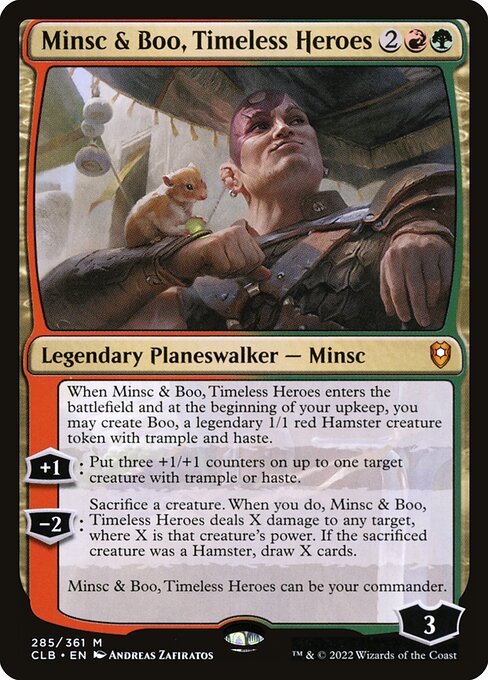



+1: Put three +1/+1 counters on up to one target creature with trample or haste.
−2: Sacrifice a creature. When you do, Minsc & Boo deals X damage to any target, where X is that creature's power. If the sacrificed creature was a Hamster, draw X cards.
Minsc & Boo, Timeless Heroes can be your commander.
What that top list is really telling you
The most-tested CLB cards fall into three buckets:
1) “Just good cards” that don’t ask for support
Minsc & Boo is the obvious headliner here, and Displacer Kitten also reads like a clean “do the thing you already do, but harder” payoff in the right environments.
2) Synergy glue for decks cubes already support
Gut and Noble’s Purse are great examples: not because the set’s marquee mechanics matter, but because those cards plug directly into sacrifice shells and artifact shells.
3) Mechanics packages (high upside, higher friction)
Monster Manual represents the “cheat” redundancy crowd. Initiative cards like White Plume Adventurer show up too, but notice how Initiative did not dominate the very top of the list. Extra game objects, extra steps, and “do we all remember how this works” overhead can suppress adoption even when the power is real.
The surprise winner: the Gate taplands
One of the most interesting findings is that CLB’s highest-rated cards were not the most-tested splashy rares. The Gate tapland cycle (like Sea Gate, Manor Gate, etc.) posted an extremely high average rating while being tested by a smaller slice of respondents.
That pattern makes sense: those lands are especially attractive to budget, rarity-restricted, and lower-power cube environments where “clean fixing that also enables a theme” is premium. If your cube likes Gates at all, this is a “why wouldn’t I” add. If your cube doesn’t care about Gates, they are still perfectly serviceable fixing, just not exciting.

A practical test plan that actually works
If you want to add CLB cards without turning your cube update into a six-week side quest, here’s the clean approach:
- Start with the broad staples: Minsc & Boo, Gut, Noble’s Purse, and one of the clean role-players (Winter Eladrin or Delayed Blast Fireball depending on your power band).
- Pick exactly one package to try next:
- Sacrifice/aristocrats: Gut, Mahadi, Altar of Bhaal, plus whatever token fodder you already run.
- Artifacts/value: Noble’s Purse and one or two “artifact matters” payoffs you already support.
- Cheat/big monsters: Monster Manual as redundancy if you want another “Piper-ish” effect.
- Initiative mini-game: White Plume Adventurer or Seasoned Dungeoneer, but only if you’re happy carrying the rules overhead at the table.
- Budget fixing / Gates: try the Gate cycle and see if it improves deck play patterns immediately.
The big win with CLB is that you can treat it like a menu. Take one plate, not the whole buffet.
Conclusion
CLB is a strong example of a “less-discussed set” that still has cube staples hiding inside it. The survey data suggests most curators weren’t going deep, but the people who did often sounded genuinely excited, especially in theme-forward environments (D&D cubes, multiplayer cubes, and synergy-heavy lists).
If you like testing cards that have not already been fully solved by Constructed content cycles, CLB is exactly the kind of set that rewards good cube instincts.
FAQ
Are Battle for Baldur’s Gate cards “legal” in MTG cube?
Cube is a curated format, so you can include whatever you want. If you care about mirroring Constructed legality, CLB’s new cards were designed for Commander-focused play and show up in Eternal format conversations rather than Standard.
Are Backgrounds worth caring about in a normal 1v1 cube?
Usually not as a mechanic. Many curators test Background cards because the front half of the card is good enough, not because “choose a Background” is relevant. Backgrounds matter more in Commander cube variants.
Is Initiative worth the rules baggage?
It depends on your group. Initiative can add a fun clock and meaningful decisions, but it also adds a shared game piece and extra steps. If your table already enjoys dungeons-style complexity, it can be great. If your table wants “shuffle, draft, play” simplicity, it is often a pass.
Why did the Gate lands rate so highly?
Because they fill a real need: consistent fixing that also enables a theme in environments where expensive land suites are off the table or undesirable.