
This post helps cube designers make cuts in an MTG cube without losing what makes their environment special by using a simple decision framework (philosophy, size, role, curve, support), so updates stay intentional instead of stressful.
TLDR
- Cuts get easier when your Cube has a clear mission. Write a one-sentence philosophy, then judge every card against it.
- Your Cube size defines what a “slot” means. In 360, a card shows up every full draft. In larger cubes, narrow cards need stronger justification.
- Most “hard cuts” are really curve cuts or role cuts. If your 4s and 5s are bloated, you are going to feel it in every draft.
- Synergy cards are packages, not singles. If you add or remove one build-around, revisit the surrounding support.
- Keep a bench. The fastest way to iterate is to cut cards into a labeled “maybe later” module instead of banishing them forever.
A framework for making cuts in an MTG cube
At the beginning, making cuts in an MTG cube feels impossible because everything is exciting. You get to relive old decks, jam favorites, and chase that “best hits” feeling. Then sets keep coming out, your list gets tighter, and you hit the part every curator eventually faces: you either expand the Cube, or you start slaughtering your darlings.
The trick is to stop treating every cut like a referendum on your taste.
Instead, treat it like a design decision with a few repeatable questions. Here’s the filter I like for making cuts in an MTG cube:
- What’s your fundamental Cube philosophy?
- What’s your target Cube size, and why?
- What does this card add (that you don’t already have)?
- What does your curve want to look like?
- Do you have enough support for this card or theme?
If a card fails two or more of these checks, it’s usually a cut. If it fails only one, it might be a “rotate” instead of “remove.”
1) What’s your fundamental Cube philosophy?
Every Cube shares one goal, have fun playing Magic. But “fun” is not one thing.
Some groups want the swingiest, most memorable games possible. Others want tight interaction, lots of marginal decisions, and fewer “oops” wins. Some cubes are museums of the best cards ever printed. Others are a chance to showcase underloved designs that never had a home in Constructed.
Before you cut a single card, write a one-sentence mission statement. Examples:
- “High power, but interactive.”
- “Nostalgia-first, even if it’s not optimal.”
- “Synergy decks should reliably come together.”
- “Draft fundamentals matter more than haymakers.”
Then add 2–3 “non-negotiables” that reflect your group:
- “Aggro must be real.”
- “No hard locks.”
- “Gold cards are signposts, not traps.”
- “We want to play the splashy top end.”
This does two things:
- It makes cuts feel less personal.
- It exposes the real reason you are stuck: you are trying to serve two different cubes at once.
A useful reminder from cube design writing is that your “perfect balance spreadsheet” is never going to be perfectly true in practice, because cards overlap and create archetypes you did not plan for. That’s normal. It means you should aim for direction, not perfection.
Quick gut-check
If you are “power maxing,” raw power becomes a harsh metric. Most cards won’t make the cut, and that’s okay. If you are “experience maxing,” the question becomes, “Does this create better drafts and better games for our table?”
2) What’s your target Cube size, and why?
Cube size is not just a number. It determines:
- How often cards show up
- How reliable synergy decks are
- How quickly drafts feel “solved”
- How painful every update becomes
Here’s the baseline math most players anchor to:
- 8 players × 3 packs × 15 cards = 360 cards drafted
- So in a 360-card Cube, an 8-player draft uses 100% of the Cube.
- In a 450-card Cube, that same draft uses 80% (360/450).
- In a 540-card Cube, it uses 66.7% (360/540).
That “use rate” matters when you’re making cuts in an MTG cube because it answers a brutal question:
Do you want this card to appear every draft, or only sometimes?
A smaller cube tends to reduce variance and make draft signals clearer, but it also means your metagame can get familiar quickly, and adding new cards becomes stricter because every addition displaces something.
Larger cubes buy you variety, but you pay in consistency and archetype density.
If you want a compact guide to matching size to your typical pod and pack plan, PrintACube’s “Choosing an MTG Cube” page lays out common player-count math and size tradeoffs in one place.
A practical size rule for cuts
- At 360: A new card should be something you are happy to see basically every draft.
- At 540+: You can keep more “spice,” but narrow build-arounds need more deliberate support because they will not always show up.
Table: what a cut “means” at different cube sizes
| Cube size | 8-player draft use rate (3×15) | What it rewards | What it punishes | What to cut first |
|---|---|---|---|---|
| 360 | 100% | Consistency, synergy reliability, clear signals | Repetition, tight slots | Redundant role-players and underperforming curve slots |
| 450 | 80% | More archetypes, more variety | Density problems begin | Narrow cards without redundancy, or “extra” top-end |
| 540 | 66.7% | Variety, pet cards, replayability | Synergy whiffs, diluted lanes | Unsupported build-arounds, overlapping 5-drops, “only good in one deck” cards |
3) What does this card add?
This is the “role” question, and it’s where most cuts become obvious.
When you consider adding a new card, ask which bucket it falls into:
- A strict upgrade (same job, better rate)
- A sidegrade (same job, different play pattern)
- A redundancy add (you want more of an effect)
- A new archetype signal (you’re expanding what decks exist)
Often, there’s already something doing a similar job. Then the choice is usually:
- Swap one-for-one, or
- Commit to a broader change (like pushing a theme)
Example: when Boon Satyr entered the conversation for many cubes, some players swapped out Wolfir Avenger. That’s a one-slot philosophy: “I want one green flash threat like this, and Satyr performs better.”
But another curator might see Boon Satyr as permission to do something bigger:
- increase the density of flash threats
- reward “play at instant speed” patterns
- reshape green’s identity slightly
Both approaches are correct. The key is being honest about which one you are doing.
A simple “adds something” checklist
Keep the card (or make room for it) if it does at least one of these:
- Creates a new decision point (not just raw stats)
- Supports multiple archetypes
- Fixes a known weakness (curve, interaction, mana, answers)
- Improves draft texture (signals, pivots, fewer traps)
- Has unique gameplay you actually want (not just novelty)
If it does none of those, it’s probably just “another good card,” and those are the easiest cuts when space is tight.
4) What does your Cube’s curve want to look like?
If making cuts in an MTG cube feels hard, check your 4s and 5s.
Cube designers love powerful 4-drops and 5-drops because they are often the most impressive cards in a color. The danger is that you end up with a Cube where:
- early turns are about setup and removal
- the game “starts” at turn 4
- decks look suspiciously similar at the top end
A classic cube-design warning is: keep your 4-drops in check, because too many game-changing effects clustered at 4 mana can make games hinge on “who resolved their 4 first,” instead of producing a smoother flow of decisions.
The real-world logjam example (red 5s)
Let’s say you want to run Stormbreath Dragon, but you already have:
- Thundermaw Hellkite
- Siege-Gang Commander
- Zealous Conscripts
That is a very normal problem: too many great cards competing for the same slot.
A clean solution is what you did in the prompt: swap the closest neighbor for a test window. You learn more by replacing Thundermaw for Stormbreath (temporarily) than by trying to squeeze both in and cutting a random 2-drop instead.
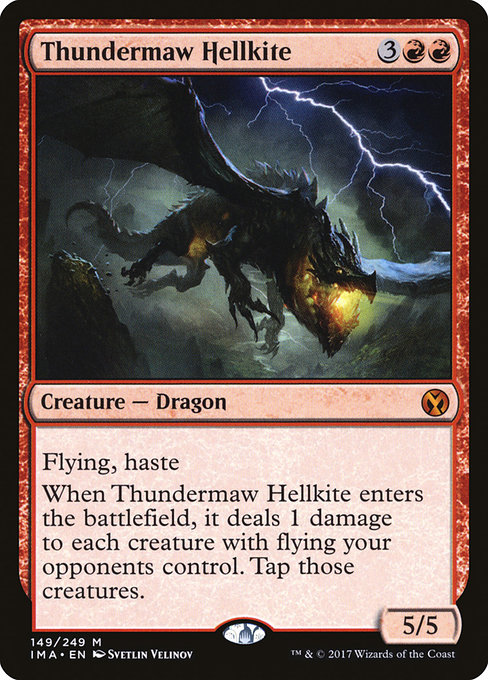

Haste (This creature can attack and
 as soon as it comes under your control.)
When this creature enters, it deals 1 damage to each creature with flying your opponents control. Tap those creatures.
A curve audit you can do in 10 minutes
- Sort each color by mana value.
- Count creatures vs noncreatures at each mana value (especially 1–3 and 4–6).
- Look for “gluts,” usually 4 and 5.
- Ask: which archetypes are paying for this glut? Aggro usually pays first.
- If adding a 4 or 5, strongly consider cutting a 4 or 5.
If you like where your Cube is on speed and gameplay texture, your cuts should reinforce that. If you do not like it, curve is one of the fastest levers you can pull to change the entire feel of the environment.
5) Do you have enough support for this card?
Most cards can be judged on their own. Synergy cards cannot.
If you are deciding whether to run a build-around like Sneak Attack, you are not adding “one card.” You are adding:
- the build-around
- the targets
- the ramp or cheat redundancy (maybe)
- the interaction and counterplay that keeps it honest
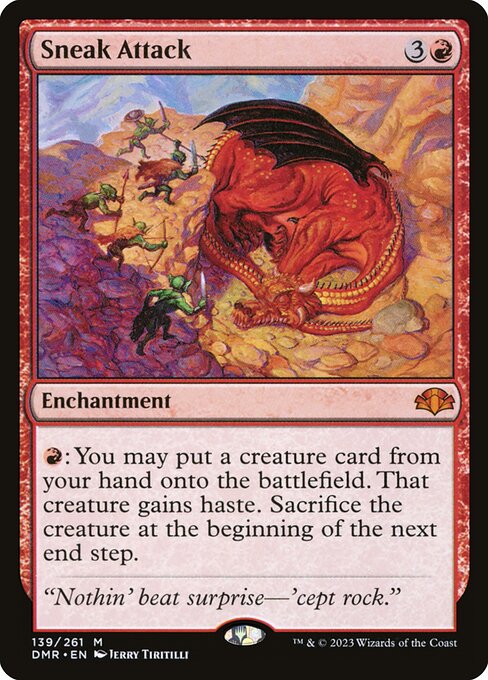 : You may put a creature card from your hand onto the battlefield. That creature gains haste. Sacrifice the creature at the beginning of the next end step.
That’s why these cuts feel so emotionally expensive. They are not one card, they are a micro ecosystem.
The support question, asked correctly
Instead of “Is Sneak Attack powerful?” ask:
- Do I have enough targets that are worth cheating?
- Do I have enough ways to find it (tutors, redundancy, card selection) for my cube size?
- Do I have enough counterplay that games don’t become repetitive?
- If I cut it, which other cards become less necessary?
Your example nails the cascading effect: if Sneak Attack is in, you might choose Woodfall Primus over Terastodon because the package wants specific kinds of hits. If you later cut Sneak Attack, you should revisit those “support-motivated” choices.
A rule of thumb for synergy packages
If a deck needs a critical mass (Storm, Reanimator, Wildfire shells, artifact engines), track the density explicitly. Bigger cubes need more redundancy because any single piece shows up less often.
And if you are considering breaking singleton to hit that density, it’s worth reading PrintACube’s breakdown of when singleton helps and when duplicates improve gameplay.
A repeatable workflow for Cube updates
Here’s a simple process that keeps “making cuts in an MTG cube” from turning into an endless group chat debate.
Step 1: make a candidate list (bigger than you need)
Pick:
- 5–15 cards you want to test in
- 10–25 possible cuts (yes, more than the adds)
That over-selection reduces stress. You are no longer hunting for “the one cut,” you are comparing reasonable options.
Step 2: label each candidate cut by why it’s on the list
Examples:
- “Curve glut”
- “Redundant role”
- “Doesn’t match philosophy”
- “Support card for a package we no longer run”
- “Underperforms in play”
If you cannot write a reason, it probably should not be on the list.
Step 3: make the easy cuts first
The easiest cuts are usually:
- redundant effects that do not add play pattern variety
- expensive cards in an already crowded mana value slot
- synergy pieces without density
- cards that only one drafter ever plays, unless that’s your explicit goal
Step 4: test in a controlled way
If possible:
- swap like-for-like (5-drop for 5-drop)
- give the change 2–4 drafts before you declare it “failed”
- keep notes on what actually happened, not what you expected
Step 5: keep a “Cube bench” instead of a graveyard
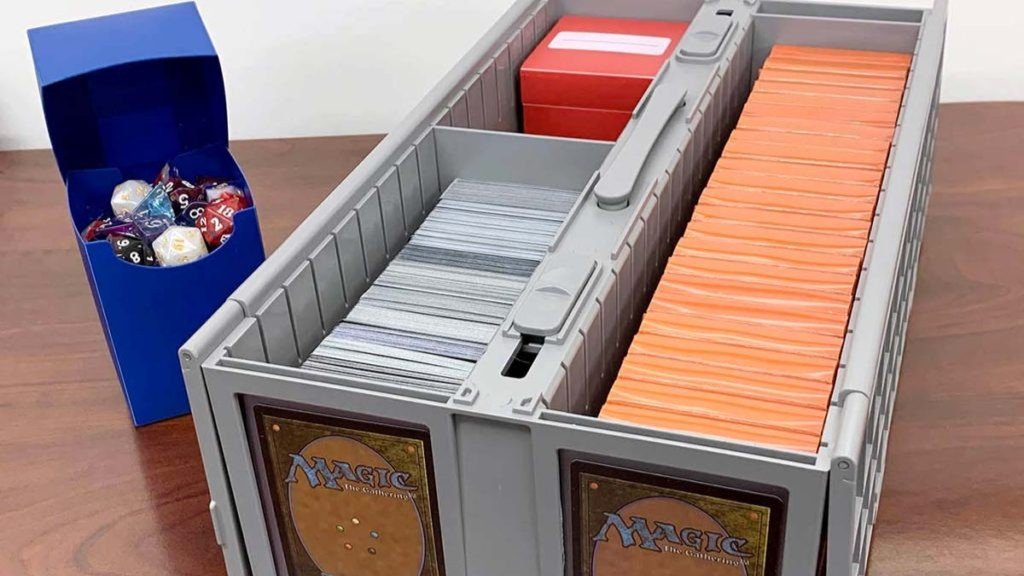
When you cut cards, sleeve them and store them in a small, labeled module:
- “5-drop finishers”
- “graveyard package”
- “pet cards”
- “rotation candidates”
This makes iteration fast, and it preserves the emotional truth: you did not “kill” the card, you just took it out of the current season.
If your Cube is printed, make cuts feel clean
Printing does not change what makes a card good. But it does change how pleasant iteration feels.
A few practical habits help:
- Version your list (even just “v1.7, February 2026”).
- Reprint only what changes so the cube stays consistent.
- Keep physical consistency (alignment, cut, finish, sleeve choice) so shuffling and stacking still feel uniform.
PrintACube’s printing priorities are basically the same things cube players notice instantly at the table: readability, consistent sizing, and shuffle feel.