

This post helps MTG cube designers decide how many planeswalkers to run by explaining how planeswalkers change combat, card advantage, and game feel, so they can keep aggro viable and games fun.
TLDR
- Planeswalkers in MTG cube are powerful because they soak attacks, generate repeatable value, and demand immediate answers.
- High planeswalker density quietly buffs midrange/control and taxes aggro, since attackers get “diverted” away from the player.
- Aim for a target number of planeswalkers per 8-player draft (360 cards), then scale that number to your cube size.
- If you want more planeswalkers, you usually also need more cheap interaction, more haste/reach, and fewer “free blockers” planeswalkers.
- The goal is not “no planeswalkers.” The goal is planeswalkers showing up as a spice, not the default win condition.
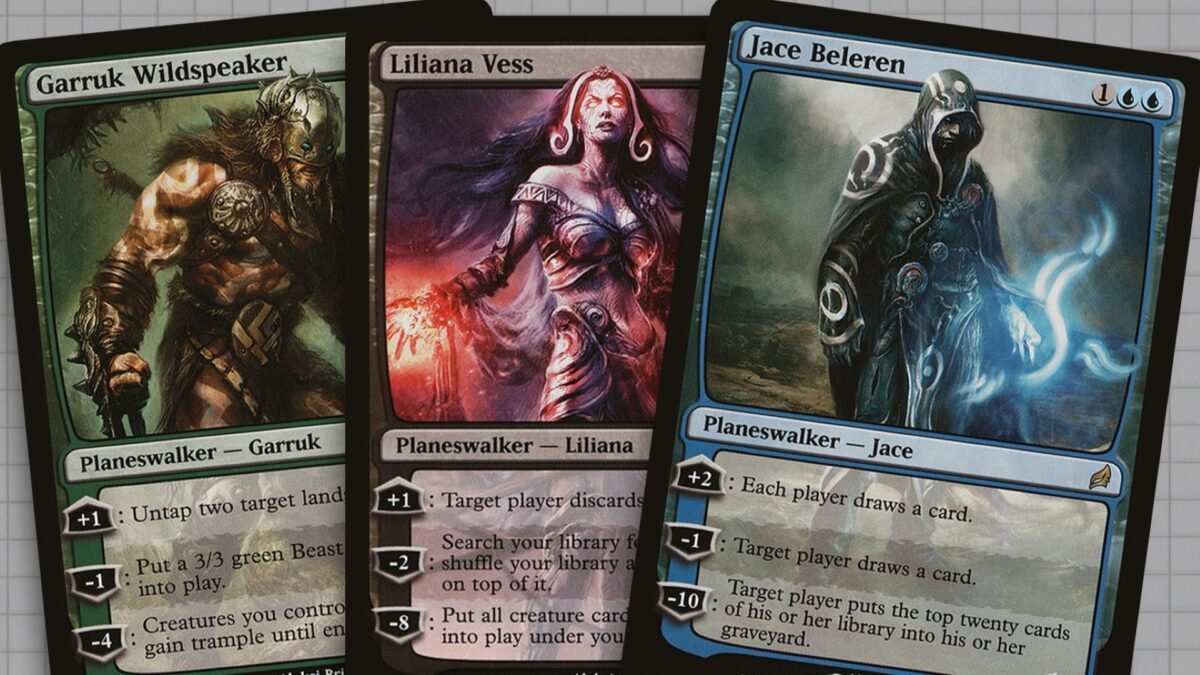
Planeswalkers in MTG cube are some of the most “Magic” cards ever printed: iconic characters, splashy abilities, and a built-in minigame around loyalty. Justin Parnell summed up the addiction pretty cleanly: “I love planeswalkers. You love planeswalkers.” That is still the vibe.
But cube is the one format where you are the developer. If planeswalkers start turning your drafts into the same gameplay loop every round, you are allowed to edit the patch notes.
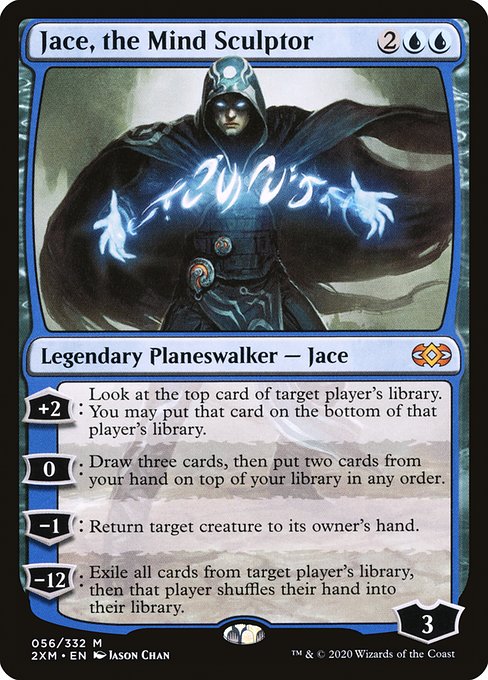

0: Draw three cards, then put two cards from your hand on top of your library in any order.
−1: Return target creature to its owner's hand.
−12: Exile all cards from target player's library, then that player shuffles their hand into their library.
Why planeswalkers in MTG cube hit differently than in Constructed
In rules terms, planeswalkers are straightforward: opponents can attack them, and damage removes loyalty counters. In gameplay terms, that simplicity hides a huge cube implication: planeswalkers convert combat damage into a “side quest.”
When a player declares attackers, they can aim those creatures at you or at a planeswalker you control. Once attackers are pointed at a planeswalker, that damage is no longer pressuring life total. It is pressuring loyalty.
In Constructed, decks are tuned to punish that tempo loss, or to protect their own walkers efficiently, or to kill opposing walkers on the stack. In cube, deck consistency is lower and answers are less redundant. That makes each resolved planeswalker more likely to “stick” long enough to matter.
Thea Steele’s classic cube take is basically: the cube plays like Limited more than people admit, and in Limited, being up a turn or a card is often the whole game. Planeswalkers are built to do both.
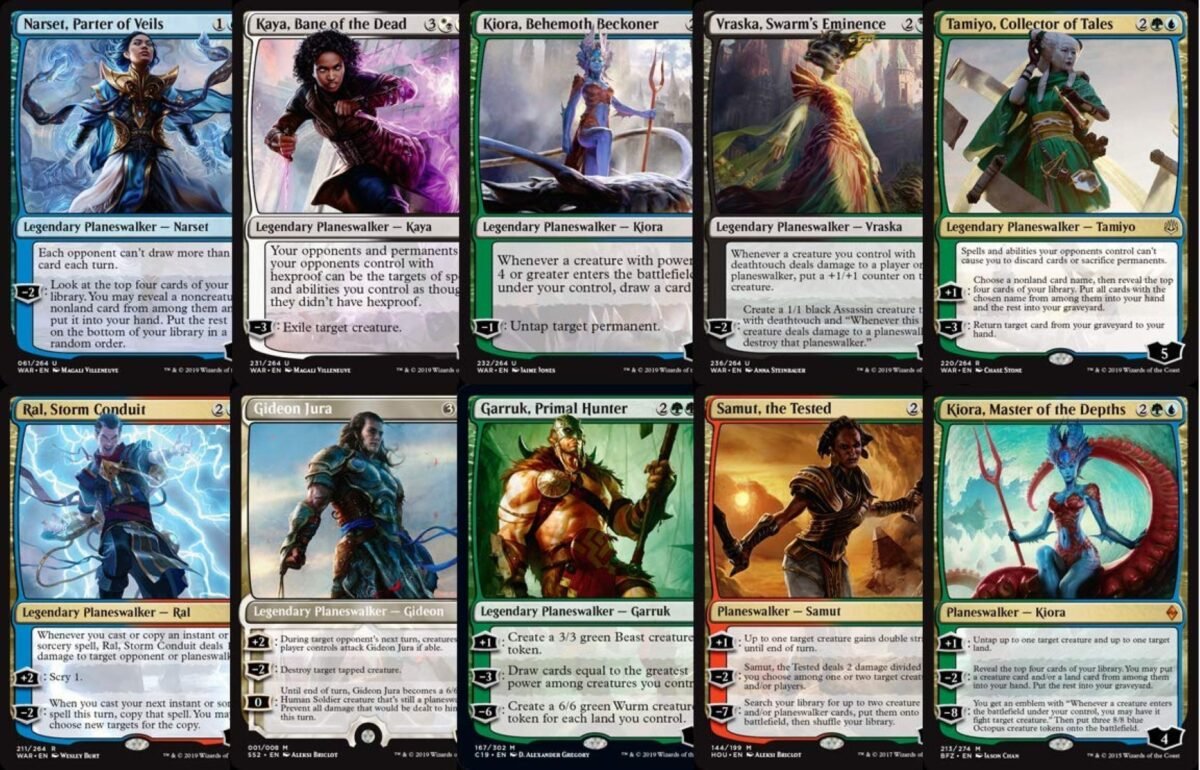
The three main ways planeswalkers warp a cube
1) “Virtual life gain” that slows aggro
The cleanest way to remove a planeswalker is still combat. That means the aggressive deck is forced into an awkward choice:
- Keep sending damage at the player and lose to the planeswalker’s snowball.
- Send damage at the planeswalker and give the opponent extra turns to stabilize.
That’s already a tax on aggro. Then you add the most common planeswalker self-defense pattern: make a blocker.
Here’s the classic cube moment:
You curve out, you’re ahead, and then your opponent taps four mana and drops a walker that makes a token, or shrinks your attacker, or threatens a must-answer ultimate. Suddenly your clean aggro math is gone, because every combat step now includes “also kill this planeswalker.”
A good example of this play pattern is Elspeth making chump blockers while ticking up loyalty, buying time until the board flips.
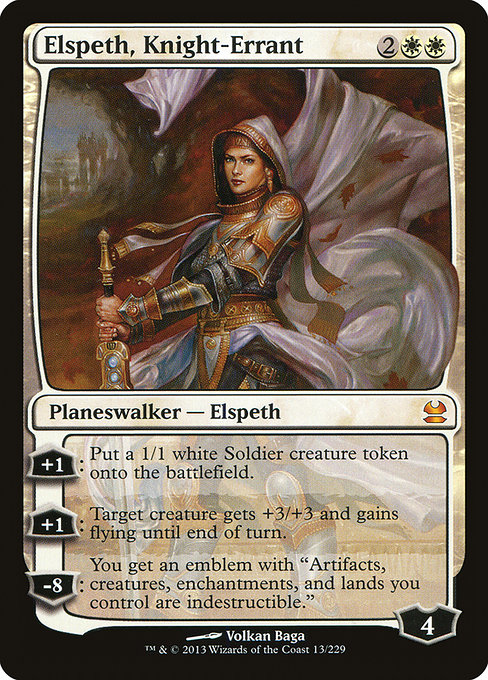

+1: Target creature gets +3/+3 and gains flying until end of turn.
−8: You get an emblem with "Artifacts, creatures, enchantments, and lands you control have indestructible."
Even when the planeswalker eventually dies, it often functioned like a fog spread across multiple turns. That is why cube designers who “push aggro” are often the first ones to cap planeswalker count.
2) Repeatable card advantage (and “turn advantage”)
Planeswalkers are value engines by default. Even “fair” walkers tend to do one of these every turn:
- Draw a card (or generate card-like resources)
- Kill or neutralize a creature
- Create a body
- Improve board position in a way that forces a response
In cube, where many games are decided by small deltas, that repeatability matters a lot. It is not just “they drew a card.” It is “they drew a card every turn while also demanding attacks.”
This is also where removal texture matters. Some of the most famous cube removal spells were printed before planeswalkers existed, and a surprising number of “universal” answers still do not cleanly answer them. That mismatch is one reason planeswalkers can feel stronger in cube than you expect from your Constructed intuition.
3) Game feel: the “planeswalker wars” problem
Even if your environment is balanced on paper, a high planeswalker density changes what games feel like.
Once both players have a planeswalker, the board often reorganizes around loyalty math instead of life totals. Combat becomes less about racing and more about managing a rotating set of must-answer permanents.
Some groups love that. Others feel like it stops being “classic Magic” and starts being a different subgame where planeswalkers are the main characters and creatures are supporting actors.
Neither preference is wrong. The important part is noticing when your cube’s identity is drifting.
A practical density framework using cube math
Instead of asking, “How many planeswalkers should I run,” I think the better question is:
How many planeswalkers do I want to show up in the average 8-player draft?
Baseline cube math (the one that keeps us honest):
8 players × 3 packs × 15 cards = 360 cards drafted.
So we can define a simple “seen in draft” target:
Expected planeswalkers in draft pool = (Planeswalkers in cube) × (360 ÷ Cube size)
That lets you pick a gameplay goal first, then scale the number to your cube size.
Here’s a table you can actually use:
| Cube size | If you want ~12 walkers in the 360-card draft pool | If you want ~15 walkers in the 360-card draft pool | If you want ~18 walkers in the 360-card draft pool |
|---|---|---|---|
| 360 | 12 | 15 | 18 |
| 450 | 15 | 19 | 23 |
| 540 | 18 | 23 | 27 |
| 720 | 24 | 30 | 36 |
How to interpret this without overthinking it:
- ~10–12 “seen in draft”: planeswalkers are present, but not the dominant texture.
- ~13–16 “seen in draft”: planeswalkers are common, and your environment needs to be built with that in mind.
- ~17+ “seen in draft”: you are choosing a planeswalker-forward cube, whether you intended to or not.
This also explains a classic cube observation from Justin Parnell: even very different cube sizes can end up with similar planeswalker counts, because people are unconsciously tuning to “how many show up” rather than “what percentage of the list is planeswalkers.”
Choosing planeswalkers that play well
Not all planeswalkers create the same problems. If you want planeswalkers in MTG cube without the worst play patterns, prioritize walkers that are one (or more) of these:
- Modest value, not runaway: they give something, but they do not dominate on resolution.
- Interactable: they can be attacked down, and they do not protect themselves too efficiently.
- Deck-context dependent: they are strong in the right shell, not auto-first-picks in every deck.
Build-around planeswalkers are often the easiest way to keep the “sweet card” feeling without making every match revolve around the same axis.
For example, Tezzeret is a real card, but it is not free. If your artifact support is shallow, it is medium. If your artifact support is deep, it is a pillar.
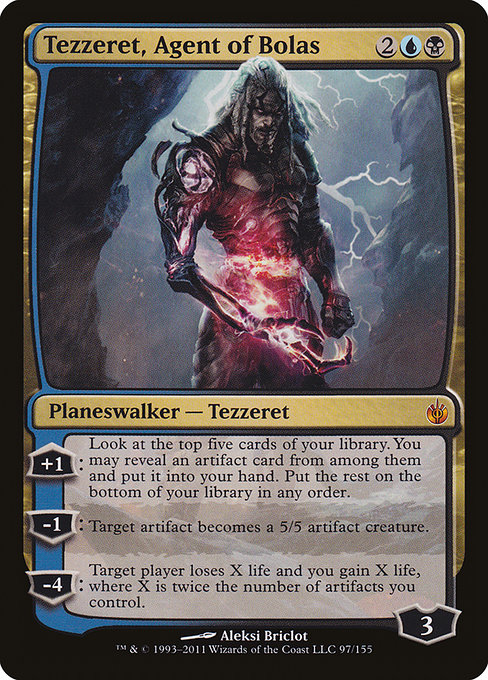

−1: Target artifact becomes an artifact creature with base power and toughness 5/5.
−4: Target player loses X life and you gain X life, where X is twice the number of artifacts you control.
Ryan Overturf described this “modest planeswalker” idea well in the context of cube environments: some walkers are beloved, some generate groans, and a lot depends on whether the environment makes them feel dominant or merely meaningful.
If you want more planeswalkers, add these safety rails
If you increase planeswalker density, you are not just adding threats. You are changing what kinds of answers matter, and how fast games can realistically end. If you want the cube to stay balanced, you usually need to add pressure and interaction to match.
Here are the safest adjustments, in order:
- Increase cheap interaction that can answer walkers (direct damage that can hit “any target,” flexible removal, evasive pressure).
- Increase reach for aggro (haste creatures, burn that closes games, equipment that punches through tokens).
- Be cautious with “makes a blocker every turn” walkers because they compound the aggro tax.
- Trim other time-buying effects (extra sweepers, extra incidental lifegain, slow value enchantments) if your environment is already grindy.
- Treat planeswalkers as a section you actively curate, not a pile that only grows with new set releases.
If you want a broader cube balance checklist (especially for aggro density and cheap removal targets), this PrintACube guide pairs well with the planeswalker question:
https://printacube.com/mtg-cube-ratios-color-balance-lands-artifacts-removal-and-aggro-density/
Draft-night considerations for planeswalkers in a printed proxy cube
Planeswalkers add some physical table needs that cubes sometimes forget until the first game:
- Loyalty tracking must be effortless. Dice work, but only if your prints are crisp enough that everyone can read starting loyalty and ability costs quickly.
- Token logistics matter more. Walkers that make tokens every turn are not just balance levers, they are setup and cleanup levers.
- Oracle text consistency matters for “damage can hit walkers” cards. Modern templating uses “any target” to clarify that spells can hit players, creatures, or planeswalkers.
If you care about readability and consistent handling (especially when your cube includes information-dense planeswalkers), this is the PrintACube printing spec we optimize around:
https://printacube.com/our-printing/
FAQs
Are planeswalkers “too strong” for cube?
Not inherently. Planeswalkers are strong by design, but cube power level is not the only variable. Density and environment context matter more. A few planeswalkers can be exciting punctuation. A lot of planeswalkers can become the default win condition.
How many planeswalkers should I run in a 360-card cube?
A solid starting range is to target roughly 12–15 planeswalkers showing up in an 8-player draft, which in a 360-card cube is literally 12–15 planeswalkers total. Go lower if you push aggro hard. Go higher if you want a grindier midrange experience.
What is the biggest reason planeswalkers hurt aggro?
Combat damage gets diverted away from life totals toward loyalty, and many planeswalkers also generate blockers. Both effects buy time, and aggro decks are built on the assumption that time is scarce.
Should I move planeswalkers into gold to reduce how often they show up?
That can work. Making planeswalkers harder to cast is a real cost, and it can turn “free value engines” into “reward for drafting fixing and committing to a lane.” Some designers use this as a knob to keep planeswalkers powerful but less universal.
How do I keep planeswalkers from creating “planeswalker wars”?
Reduce density, and be picky about which walkers you include. Avoid stacking too many walkers that protect themselves, generate repeated blockers, or invalidate combat. If your group dislikes walker-heavy games, the cleanest fix is simply fewer walkers.
Do I need to change anything in my cube night setup if I add more planeswalkers?
Yes, a little. Make sure you have enough dice/counters for loyalty, and enough tokens (or token substitutes) for the walkers you run. Planeswalkers increase the number of “game objects” on board, so the table needs to support that without friction.