
Should Your Cube Basic Lands Match? Function, Aesthetics, and Draft Table Clarity
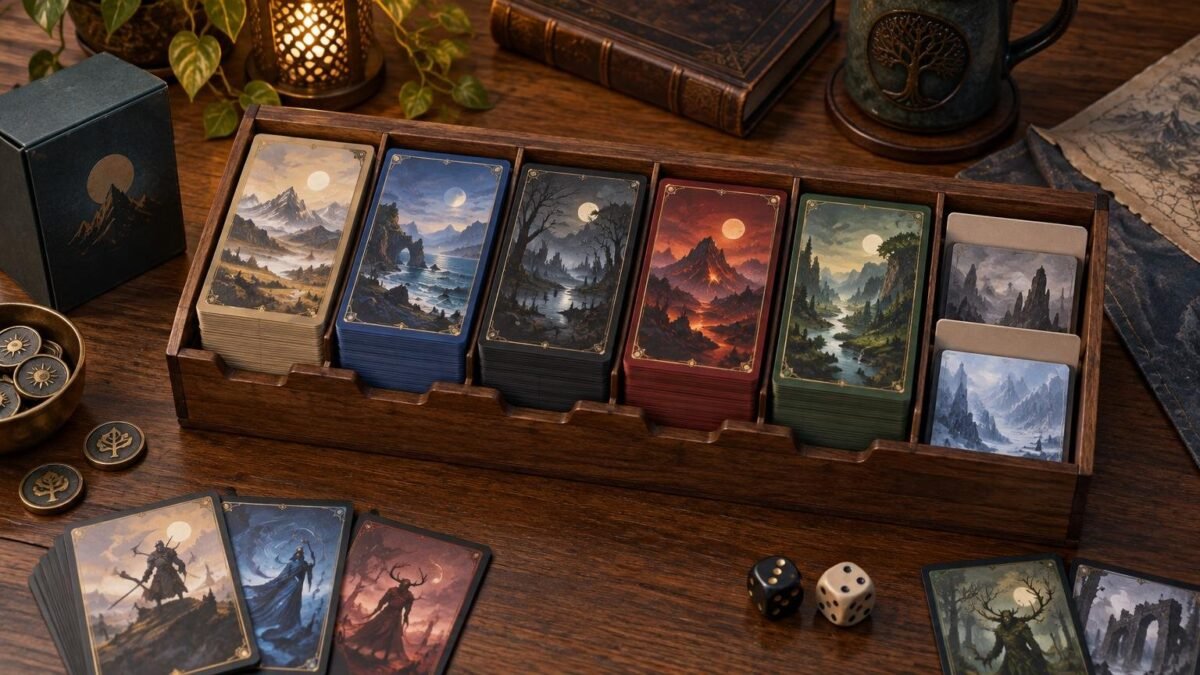
Table of Contents
TLDR: Your Cube’s basic lands do not need to match, but a coherent package makes the environment feel intentional and can make deckbuilding, sorting, and resetting easier. Choose one visual rule broad enough to cover all five colors, prioritize rapid color recognition over perfect uniformity, and keep mechanically distinct lands such as snow-covered basics and Wastes separate. Before printing, decide whether basics belong in the submitted list or in a separate land station, then document quantities and versions clearly.
A cube basic land art theme is partly an aesthetic choice and partly an operating-system choice. The art affects how the Cube presents itself, but the package also has to support several people building decks at once, finding the right colors quickly, and returning hundreds of cards to their proper sections after the draft.
The best default is not “make every land identical.” It is “apply one recognizable visual rule without sacrificing function.” That rule might be one plane, one set, one artist, one frame treatment, or one consistent mood. If players can identify colors immediately and the owner can reset the station without inspecting collector numbers, the theme is doing useful work.
Why give Cube basics a shared visual identity?
Basic lands occupy more visual space during deckbuilding and play than their Cube-list count suggests. A drafter may add seven or eight copies of one basic type, spread them across a battlefield, and handle them in every game. A coordinated land package therefore reinforces the Cube’s identity repeatedly rather than appearing as a one-off novelty.
Matching also reduces accidental noise. A random land box can contain similar dark landscapes across multiple colors, a mixture of radically different frame treatments, and special variants that are not interchangeable. Coherence gives players a predictable visual language.
There is still no need to erase all variety. Five different Plains artworks can belong together if they share an artist, plane, border, palette, or period. Think of cohesion as a constraint, not necessarily duplication.
Choose a cube basic land art theme with one strong anchor
Start with one primary anchor rather than combining every preference at once. “Old-border lands from any set” is easy to maintain. “Old-border, winter scenes, all by one artist, from one expansion block” may leave one or more colors without a convincing option.
| Theme anchor | Why it works | Main risk |
|---|---|---|
| Single plane or setting | Supports a set, story, or flavor-driven Cube while allowing multiple artists | Some colors may have fewer suitable scenes |
| Single set or release family | Creates an immediately recognizable visual era | The available art may not give every color equal clarity |
| Single artist | Produces a strong shared visual language across colors | A complete five-color suite may be difficult to source |
| Old-border or modern-frame suite | Connects the lands to the Cube’s card-frame identity | Frame consistency does not guarantee similar art direction |
| Full-art landscapes | Creates a dramatic table presence and broad visual continuity | Busy or unusually colored art can slow color recognition |
| Seasonal or mood-based package | Works well for horror, winter, desert, or pastoral environments | A narrow mood may visually blur neighboring colors |
| Personal anthology | Lets the owner use meaningful favorites from different eras | Needs another shared rule to avoid looking random |
The Cube’s purpose should break ties. A set Cube usually benefits from lands associated with that setting. A nostalgia Cube may want an older frame or release-era treatment. A highly competitive environment can use almost any aesthetic, but strong color readability should outrank thematic subtlety. An experimental micro cube can support a stranger visual idea because its land station and player count are smaller.
Different artworks can still match
A five-color package does not need five copies of one illustration per color. Variation can improve table texture while preserving coherence. For example, use three artworks per basic type but keep all fifteen lands within one frame treatment and landscape style. Alternatively, choose one illustration per color and repeat it throughout the station for maximum sorting speed.
If you mix sets, write the rule in one sentence: “All basics are old-border landscapes,” “Every basic depicts architecture,” or “Each color uses full art from the same plane.” If the package cannot be described simply, it may be a collection of favorites rather than a theme. That can still be enjoyable, but it will require more deliberate sorting.
Readability matters more than perfect matching
Judge the package at deckbuilding distance, not by examining one card closely. Several drafters may reach into the station simultaneously under ordinary room lighting. The frame, mana symbol, name line, and overall color treatment should make each pile easy to distinguish.
- Check whether Plains still reads as white when placed beside pale Islands.
- Avoid putting visually similar blue, black, or colorless landscapes in adjacent unlabeled compartments.
- Keep each basic type in a fixed position and label the compartments when using a large shared station.
- Use one sleeve treatment across the playable Cube and basics if basics will be shuffled into decks.
- Make special land categories physically distinct instead of relying on players to inspect names.
- Test the package in small piles, because repeated art can look different from a single card viewed in isolation.
Full-art, borderless, showcase, and old-border basics can all work. None is automatically clearer than another. The deciding question is whether the chosen five-color suite maintains fast identification. A dramatic full-art package that repeatedly sends players to the name line is less functional than a mixed-art package with unmistakable colors.
Keep cosmetic choices separate from gameplay choices
The normal five-color baseline is Plains, Island, Swamp, Mountain, and Forest. Under Magic’s rules, those five basic land types each carry an intrinsic mana ability. A card’s basic supertype, however, is distinct from possessing one of those land types. The distinction matters when evaluating lands that look like basic-land alternatives. Readers checking current terminology should use the official Magic rules page as the starting point.
Snow-covered basics are not merely winter artwork
Snow is a rules-relevant supertype. Snow-Covered Island may fill the familiar blue-basic role, but it is also a snow permanent and can interact with costs, payoffs, and checks that care about snow. It should not replace an ordinary Island solely because its illustration fits a winter theme.
If the Cube intentionally supports snow, decide how access works. Unlimited snow basics from the land station can make snow mana broadly available, while drafting the relevant lands makes access a deckbuilding cost. Those approaches produce different environments. Choose the one that matches the intended archetype rather than allowing the artwork to make the decision accidentally.
Wastes needs its own category
Wastes is a basic land, but it is not a sixth version of Plains, Island, Swamp, Mountain, or Forest. It produces colorless mana rather than one of the five colors and should be stocked only when the Cube’s cards or design make that access useful. Keep it in a labeled sixth compartment rather than mixing it with another basic type.
Apply the same principle to any other land that has meaningful text, types, supertypes, or deckbuilding consequences: if the substitution changes what a card can produce or what other cards can detect, it is a gameplay component rather than an art variant.
Separate land station or self-contained Cube?
A separate land station is the flexible default. It lets the owner change quantities, replace damaged basics, and refresh the visual theme without touching the randomized Cube list. It is also easier to expand when a larger pod needs more lands than usual. PrintACube’s planning material recognizes both a separate station and basics included in a submitted Cube list as possible approaches.
A self-contained package is useful when the Cube should travel as one complete object, when a lending group should not need to supply anything, or when a curated product needs a predictable reset. If portability is the priority, plan the basic-land compartment alongside tokens, dividers, and other support pieces rather than treating basics as an afterthought. The Cube transport and organization guide covers those broader packing constraints.
Do not infer the required quantity from Cube size alone. Player count, draft method, color balance, fixing quality, and how many cards each drafter sees all matter. An eight-player draft creates a different peak demand than a two-player Winston or Grid-style session, even if both use the same underlying list. Use the framework in the practical Cube land-count guide to estimate demand, then retain a buffer for uneven color distribution and multicolor decks.
A simple land-station layout
- Place the five regular basic types in a fixed WUBRG order.
- Give every color its own labeled compartment, divider, or clearly separated stack.
- Place Wastes, snow basics, and other special categories after the regular five rather than inside them.
- Keep tokens and helper cards in a different section so they cannot be mistaken for deckbuilding lands.
- After each session, return basics by type first and inspect artwork or version only if your inventory system requires it.
For frequent drafting, operational simplicity should influence the art plan. One artwork per color is fastest to inventory. Several artworks per color add visual variety but make exact counts harder to audit. A personal anthology creates the most expressive package, yet it benefits most from labeled sections and a written inventory.
Prepare the land package for printing or ordering
Before submitting a Cube list, decide whether the listed total includes basics. A clean export should make quantities, tokens, custom-card labels, and support pieces explicit rather than forcing someone to infer them from the Cube’s theme. The Cube Cobra export guide explains the broader list-export process, while the Cube upload checklist is useful for the final count and naming pass.
The supplied PrintACube instructions distinguish ordinary name-list workflows from requests involving specific printings. When exact-version handling is available for the applicable order, version-specific data may include set codes and collector numbers in a Moxfield- or MTGO-style list. Because ordering options can change, confirm the current product workflow before assuming that every requested artwork can be selected exactly.
- Choose separate-station basics or basics included in the submitted list.
- Set a quantity for each of the five regular basic types based on expected player demand.
- List snow-covered basics and Wastes separately; do not hide them under ordinary basic totals.
- Record set codes and collector numbers when exact-version requests are supported and exact art matters.
- Check double-faced cards, tokens, emblems, and helper cards during the same inventory pass.
- Label any custom card clearly so it cannot be confused with an official card entry.
- Confirm current file, artwork, and version-selection requirements before submission.
- Use only submitted content you own or have permission to use, as required by PrintACube’s terms.
For custom art, do not assume that attractive source artwork is automatically suitable or authorized for reproduction. Confirm both the current technical requirements and your right to submit the material. PrintACube products should also be treated as unofficial proxy or play pieces rather than authentic collectible cards.
Refresh the basics without redesigning the Cube
A separate land package gives the Cube an inexpensive visual refresh lever. The main list can remain mechanically stable while the basics change for a new season, event, or setting. That is useful for a Cube that is redrafted often but updated mechanically only a few times per year.
Preserve the station’s structure when changing the art. Keep the same color order, labels, approximate quantities, and distinction between regular and special basics. Players receive a new presentation without having to relearn the support system.
The practical recommendation
Choose one visual anchor, then build a complete five-color suite around it. For most Cubes, use regular Plains, Islands, Swamps, Mountains, and Forests in a separate, labeled WUBRG station. Add snow-covered basics or Wastes only when the environment has a mechanical reason to provide them.
The best cube basic land art theme is therefore not necessarily the rarest, newest, or most uniform option. It is the package that communicates the Cube’s identity while letting drafters find lands quickly and letting the owner reset the table without friction. Write the theme rule in one sentence, test the five piles side by side, and document quantities and versions before the next print or organization pass.