
Best Two-Player Cube Draft Formats Compared
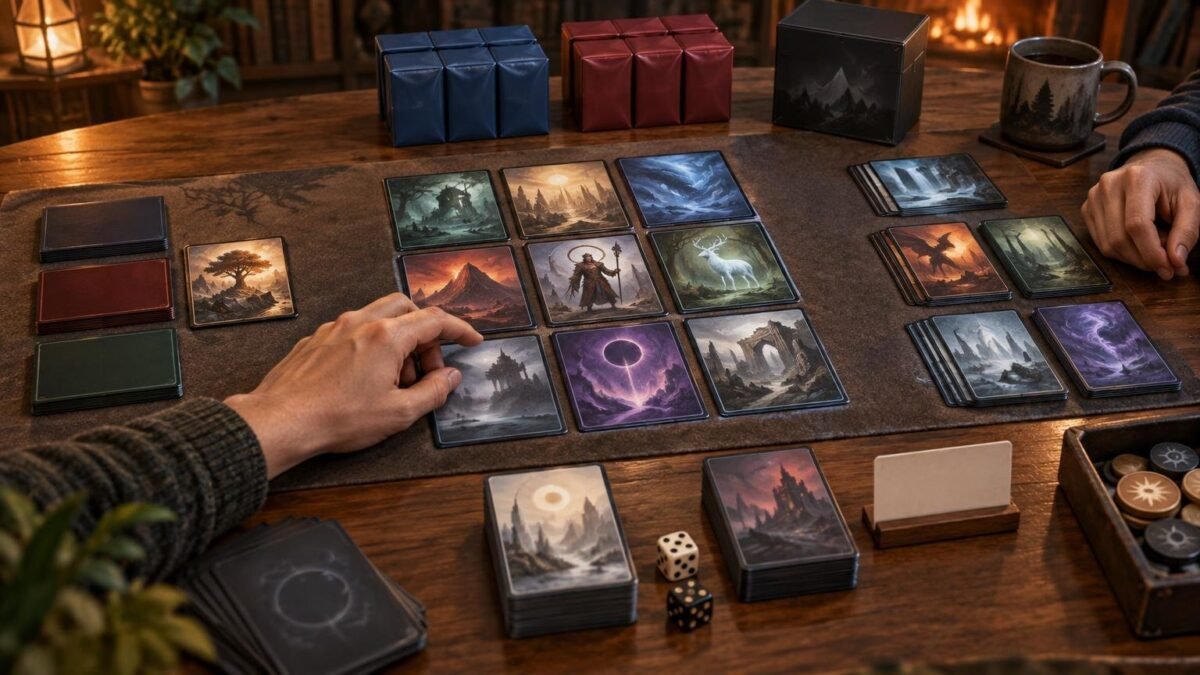
Table of Contents
TLDR: Winston is the easiest general recommendation when you want hidden information and a recognizable draft experience. Grid is best for fast, fully visible tactical drafting. Winchester turns every choice into a quality-versus-quantity decision, while Housman usually produces the most deliberately sculpted pools. Solomon emphasizes pile construction and opponent reads. Burn Draft feels closest to pack drafting, but it requires the most house-rule decisions.
The best two player cube draft formats are not merely substitutes for an eight-player pod. Each is a different drafting game. The procedure determines how many cards players see, how much information remains hidden, whether denial is incidental or deliberate, and how reliably narrow archetypes can come together.
Choose the experience before choosing the card count. If both players want uncertainty, start with Winston. If you prefer open decisions and a short setup, use Grid. If your Cube rewards intricate combinations, try Housman. These are flexible casual formats rather than immutable tournament structures; the procedures below are reproducible baselines that you can adjust after observing how they interact with your Cube. Wizards provides established Winston and Solomon baselines, while the Lucky Paper Cube format library documents several other commonly used approaches.
Quick picker for two player Cube draft formats
- Choose Winston for hidden information, suspense, and a relatively simple first two-player draft.
- Choose Grid for fast, open-information tactics and high card visibility.
- Choose Winchester for visible piles and recurring quality-versus-quantity choices.
- Choose Housman for focused decks, repeated hand sculpting, and experienced players who can evaluate interactions quickly.
- Choose Solomon for direct split-and-choose strategy, especially when both players enjoy balancing piles.
- Choose Burn Draft when you want pack-like picks and deliberate control over which cards leave the draft.
| Format | Information | Baseline card pool | Primary appeal | Main evaluation shift |
|---|---|---|---|---|
| Winston | Mostly hidden | 90 cards | Suspense and pile management | Flexible cards become safer |
| Grid | Fully open | 18 grids of 9 | Fast tactical choices | Rows, columns, and denial affect every pick |
| Winchester | Fully open | 80 cards | Quality versus quantity | Pile context can outweigh single-card power |
| Housman | Mixed | 171 cards | Deliberate pool sculpting | Synergy and interaction gain reliability |
| Solomon | Fully open during each split | 90 cards | Split-and-choose mind games | Relative pile value matters most |
| Burn Draft | Usually pack-hidden; varies | House-rule dependent | Pack-like drafting with removal | Denial and redundancy become more important |
Winston Draft: the best all-purpose starting point
For the Wizards baseline, shuffle 90 cards and place one face-down card into each of three piles. On a turn, look at the first pile. Take it or pass; when you pass, add the top card of the reserve to that pile and inspect the next one. If you pass all three piles, take one unknown card from the reserve. Whenever a pile is taken, replenish its position with a new face-down card. Continue until the reserve and piles are exhausted.
Winston works because it reveals partial information without making the entire draft public. A growing pile creates pressure: take several useful but imperfect cards now, or pass and risk giving the opponent a valuable bundle. The unknown-card rule also keeps passing from being free.
Card evaluation shifts toward flexibility. A generic removal spell, efficient threat, or broadly useful fixing land can enter several possible decks, whereas a narrow build-around may sit unused if its support remains hidden. That does not mean synergy is impossible. It means synergy needs enough redundancy that one missed pile does not dismantle the deck. For a detailed turn sequence and pile-management examples, see the complete Winston Draft guide.
Winston is a strong beginner choice because there are only three visible decision points at a time. Its weakness is uneven information: a player can occasionally receive a useful unknown card or encounter a pile whose contents line up unusually well. If your group dislikes that variance, move to an open format.
Grid Draft: fast, visible, and highly tactical
Reveal nine cards in a three-by-three grid. The first player takes one complete row or column. The second player then takes one available row or column from the remaining cards, and the unselected cards are discarded. Switch which player chooses first on the next grid. A common baseline runs 18 grids.
Grid makes spatial relationships part of card evaluation. A premium removal spell may share a row with two cards you do not want, while a different line offers three coherent role-players. Because every card is visible, players can infer colors, fixing, curve needs, and likely archetypes. Denial is direct, but taking a weak line merely to block one card is often too expensive.
This method works particularly well for micro-Cubes and high-density environments where most cards have a plausible home. It is less forgiving when the Cube contains many narrow build-arounds: those cards can be stranded in discarded lines, and both players immediately know which support pieces disappeared. Grid is usually the best choice when you want a quick draft with almost no hidden bookkeeping.
Winchester Draft: evaluate piles, not isolated cards
Shuffle 80 cards and deal one card face up into each of four piles. A player chooses an entire pile. Add one card to every unchosen pile, refill the empty position, and let the other player choose. Continue until all cards have been drafted.
Small piles tend to offer card quality; neglected piles accumulate quantity. That creates a recurring tension between taking the best individual card and collecting enough useful material to finish a deck. The pools may not remain equal in size, so agree before starting whether pool-size differences are simply part of the format.
Winchester exposes more strategic information than Winston. If one player repeatedly selects blue cards, the other can value blue denial more accurately or move into uncontested colors. Gold cards are especially sensitive to pile composition: a narrow multicolor card may be unattractive alone but effectively free when attached to fixing and two playable mono-colored cards.
Housman Draft: best for deliberately focused pools
In the documented baseline, each player starts with a hidden five-card hand and nine cards are placed face up. Players alternate exchanging one card from hand for one face-up card, with each player making three exchanges. After the exchange sequence, the players keep their five-card hands and repeat the process for nine rounds. This uses 171 cards and leaves each player with a 45-card pool.
Housman rewards planning because every exchange refines a known private pool. Players can retain an engine piece, replace an off-plan card, and use the public display to fill curve or interaction gaps. The hidden hands prevent perfect information even though the market is visible.
This tends to make synergy cards more dependable than they are in Winston. Repeated exchanges let players filter out misses, so graveyard packages, artifact clusters, or creature-type themes can reach a functional density more often. That is useful if your Cube is designed around engines, but it can also make linear decks too consistent. Increase overlapping interaction or reduce the narrowest payoffs if drafts become repetitive.
Solomon Draft: turn every group into a negotiation
For the Wizards baseline, shuffle 90 cards. The active player reveals eight and divides them into two face-up piles. The opponent chooses one pile, and the divider receives the other. Alternate divider and chooser roles. The published procedure uses a final group of 10 cards when the remaining total requires it.
The central skill is balancing unlike resources. One pile might contain the strongest card while the other has fixing, removal, and several solid playables. A perfectly equal split is rarely possible, so the divider instead tries to create two outcomes they can accept. Meanwhile, the chooser evaluates both immediate card quality and what the opponent appears to be building.
Solomon strongly rewards contextual evaluation. A narrow payoff can be valuable when bundled with its enablers, while a universally strong card can anchor the opposite pile. It suits players who enjoy visible interaction and opponent modeling more than hidden discovery.
Burn Draft: closest to packs, but define the house rules
Burn Draft modifies pack drafting by removing selected cards from the draft instead of adding every non-pick to another player's options. Configurations vary in player count, pack size, and when cards are burned. Immediate burning permits targeted denial of synergy pieces; burning cards only near the end of a pack can reduce that pressure.
For a reproducible two-player house recipe, create 12 packs of 15 cards. Open one pack at a time. Players alternate actions, and each action consists of drafting one card and burning one card face up. After seven actions, discard the single remaining card. Alternate who acts first from pack to pack. This produces 42 drafted cards per player if the starting role alternates evenly. It is an editorial house baseline, not a canonical Burn Draft rule.
Keep burns face up if you want transparent strategy and easier post-draft diagnosis. Use face-down burns if uncertainty is part of the appeal, but recognize that players then cannot tell whether an archetype failed because its support was burned, drafted by the opponent, or absent from the sampled cards. For another established pick-and-burn structure, the Pancake Draft guide covers an 11-card-pack procedure.
How the format changes card evaluation
Two-player drafting reduces the number of independent drafters competing for colors, but the chosen method can expose or remove a large share of the sampled pool. Evaluate cards according to access, not merely Cube size.
- Flexible staples improve when information is hidden. They preserve options when you cannot predict which enablers will appear.
- Narrow build-arounds need more redundancy in Winston and Grid. Hidden piles, discarded grid cards, and burns can remove essential pieces before a player has a meaningful choice.
- Synergy packages improve in Housman because repeated exchanges let players sculpt pools. Solomon can also preserve packages when the divider groups related cards together.
- Fixing becomes more contextual in open drafts. Players can see whether a land completes a pile, unlocks several gold cards, or signals a color shift.
- Gold cards need a high success rate. A multicolor card that only one narrow deck wants is more likely to become dead material when only two players are drafting.
- Interaction should overlap. Removal that answers several threat types is less fragile than a specialized answer that may never meet its intended target.
- Glue cards matter more than flashy payoffs when the format exposes fewer usable cards. Cantrips, discard outlets, flexible lands, and modal spells help incomplete packages function.
If an archetype repeatedly fails, do not immediately add more top-end payoffs. First count how many relevant cards are actually seen and retained under your preferred method. An archetype may be dense enough for an eight-player draft but too sparse after Grid discards or Burn removal. The Cube archetype density framework can help separate an enabler shortage from a payoff shortage.
Using a 360-card or 540-card Cube with two players
You do not need to draft the entire Cube. Shuffle thoroughly, take the number of cards required by the selected format, and leave the rest unseen. That preserves variety across sessions, although it increases uncertainty about whether a narrow package is present in the sample.
If two-player play is your primary use case, consider a dedicated module. Start with enough cards for your preferred format, then include basics separately along with tokens and any emblem or double-faced-card aids. Track which archetypes appeared, which cards went undrafted, and whether fixing or interaction was consistently scarce. A physical module can also be maintained as a separate list; if you decide to reproduce it as unofficial play pieces, Print A Cube states that its custom Cube workflow accepts a Cube Cobra export or a one-card-per-line list and supports quantities and custom card counts.
Change one variable at a time. Increasing the sample size, adding archetype redundancy, and switching draft formats can all strengthen decks, but doing all three together makes the cause difficult to identify. Run several drafts with the same procedure before revising the list.
Practical answers before you start
How many cards do two players need?
It depends on the method: the cited baselines use 80 for Winchester, 90 for Winston and Solomon, 162 across 18 Grid layouts, and 171 for Housman. Burn Draft depends on your pack recipe. These are starting configurations, not universal minimums.
Do two-player Cube decks have to contain 40 cards?
Wizards' Winston and Solomon descriptions use 40-card minimum decks, which is a sensible default when each player receives a conventional Limited-sized pool. A micro-Cube or custom house format may deliberately use smaller decks. Agree on deck size before drafting and make sure the available pools can support it after lands are added.
What is the difference between Winston and Winchester?
Winston uses three mostly hidden piles and lets a player pass piles in sequence, with an unknown reserve card as the fallback. Winchester uses four face-up piles, and a player chooses one whole pile on each turn. Choose Winston for uncertainty; choose Winchester for open calculation.
Which format makes the strongest decks?
Housman often produces focused pools because players repeatedly exchange cards while protecting a hidden hand. Grid can also produce powerful decks when rows and columns align well. Actual deck strength still depends on Cube density, fixing, card exposure, and how aggressively players deny one another.
Choose the draft experience first
Start with Winston if neither player has a strong preference. It is compact, partially hidden, and easy to run from a larger Cube. Move to Grid when you want a faster, fully visible contest; use Housman when deck cohesion is the priority; choose Winchester or Solomon when pile valuation is the attraction. Use Burn Draft when pack-like attrition matters enough to justify explicit house rules.
Whichever method you choose, record the card count, visibility rules, first-player rotation, burn or discard procedure, and intended deck size on a rules card. That turns a casual experiment into a repeatable environment—and gives you useful evidence for the next Cube revision.
References
- MTG Cube Draft Formats – Lucky Paper
- Casual Formats | Magic: The Gathering
- Grid Draft — Lucky Paper
- Winchester — Lucky Paper
- Housman Draft — Lucky Paper
- Burn Draft — Lucky Paper
- Print Your Own MTG Cube – Print A Cube | MTG Proxy Printing
- Frequently Asked Questions – Print A Cube | MTG Proxy Printing