
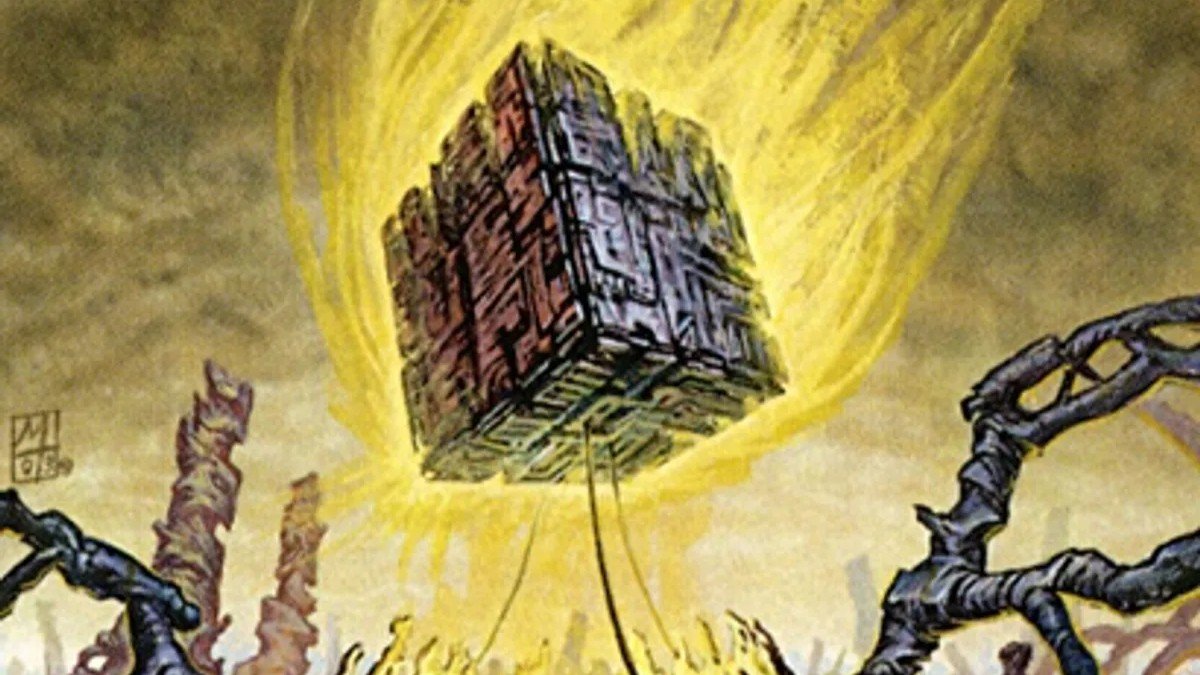
This post helps cube and Commander players use Doubling Cube correctly by explaining what it actually doubles, when it checks your mana, and the break-even math, so you can plan big turns without rules headaches.
TLDR
- It doubles what’s left. Make mana first, then pay
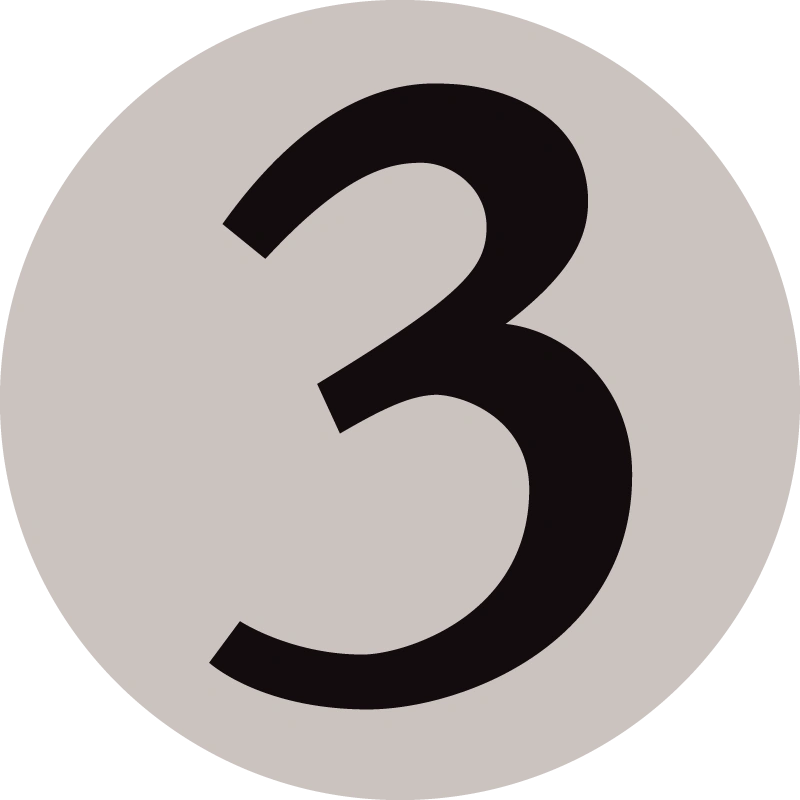 and tap it, and it adds the same amount of each mana type you still have floating.
 - It’s a mana ability. It does not use the stack, so nobody can respond to it, and you can’t do a “in response, tap my lands” trick.
- Break-even is 6 mana. If you start with 6 floating, you end with 6. You generally want 7+ floating to come out ahead.
- Your color choices matter. Because the cost is generic, you can spend the colors you don’t want to multiply, and leave the colors you do want to multiply.
- Spend it this step. Floating mana normally disappears when the step or phase ends.
How does Doubling Cube work in MTG?
Doubling Cube is an artifact that costs  and has: ,
  : Double the amount of each type of mana in your mana pool.
The key phrase is “unspent mana you have”, meaning mana currently floating (not lands, not untapped rocks, not Treasure sitting on the battlefield). When you activate Doubling Cube, you:
- Float mana first (tap lands, crack Treasures, activate mana rocks, etc.).
- Pay and tap Doubling Cube.
- It immediately adds mana equal to what you still have floating, by type (W/U/B/R/G and colorless).
A simple example (mono-color):
- You float
 (7 green).
 - Pay using three green, you now have floating.
- Doubling Cube adds .
- You end with (8 green).
A sneaky but totally legal detail: because the activation cost is generic, you can choose which colors to spend. That choice changes what remains to be doubled. If you have multiple colors floating, you can “protect” the color you want to multiply by paying the with other colors or colorless.
Also, “each type” means each mana type, including colorless. It does not mean “generic”, because generic is a cost concept, not a mana type.
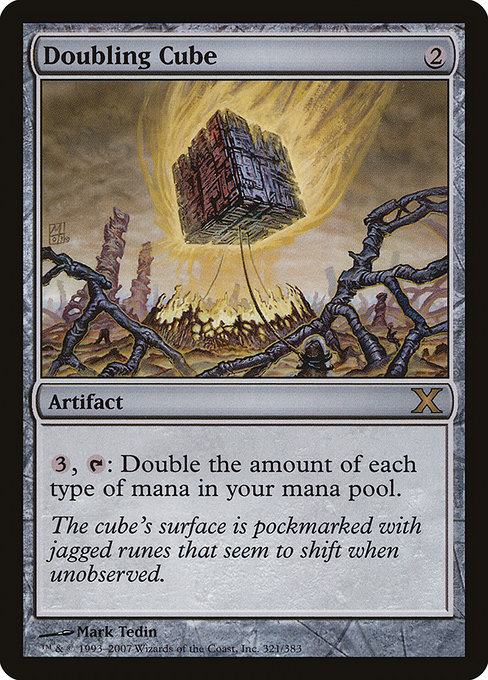 , : Double the amount of each type of unspent mana you have.
The break-even math (when is it worth activating?)
If you start with M mana floating, and you pay the out of that pool, you have (M − 3) left. Doubling Cube adds the same amount, so you end with:
Final mana = 2 × (M − 3)
Net gain = Final − M = (M − 6)
So if you’re doing the “float mana, then Cube” play pattern:
- At 6 mana floating, you break even.
- At 7 mana floating, you gain +1.
- At 10 mana floating, you gain +4.
- The bigger your pre-Cube mana, the better it gets.
Here’s the quick chart:
| Mana floating before Cube (M) | Pay → mana left | After Doubling Cube | Net change vs. M |
|---|---|---|---|
| 4 | 1 | 2 | -2 |
| 5 | 2 | 4 | -1 |
| 6 | 3 | 6 | 0 |
| 7 | 4 | 8 | +1 |
| 8 | 5 | 10 | +2 |
| 9 | 6 | 12 | +3 |
| 10 | 7 | 14 | +4 |
| 12 | 9 | 18 | +6 |
The rules gotchas people mess up
- It doesn’t use the stack. Doubling Cube’s activated ability is a mana ability, so it resolves immediately and can’t be responded to, countered, or “copied from the stack” like normal activated abilities.
- You can’t “in response” add more mana. Since there is no stack window, you must float your mana before you activate it.
- Mana disappears between steps and phases. You usually need to activate Doubling Cube and spend the mana in the same step or phase.
- Mana restrictions don’t copy cleanly. If some of your floating mana has a spending restriction (for example, “only to cast creature spells”), the mana Doubling Cube adds is new mana produced by Doubling Cube, and it won’t automatically inherit the same restriction.
- Your payment choices shape the outcome. Since the cost is generic, you can spend the colors you don’t need and leave the ones you do need to get doubled.
Where Doubling Cube actually shines (especially in Cube)
In cube environments, Doubling Cube is best when you can reliably do two things:
- Make 7+ mana in one main phase, often via big ramp, lands that tap for multiple mana, or strong artifact mana.
- Have expensive payoffs (big threats, huge X-spells, or backbreaking multi-spell turns).
If your cube is lower-curve and more tempo-focused, Doubling Cube can play like a trap: it asks you to spend turn and mana doing “nothing” unless you already have a big-mana engine online.
A nice rule of thumb for cube drafting: if you cannot picture your deck routinely floating 7–10 mana before activating Cube, you probably want a different ramp piece.
FAQs
Does Doubling Cube double the mana I spend to activate it?
No. You pay costs first, which reduces your floating mana, and Doubling Cube doubles what remains.
Can opponents respond to me activating Doubling Cube?
Not in the usual way. Because it’s a mana ability, it does not go on the stack and resolves immediately.
Does it double colorless mana too?
Yes. Colorless is a mana type, and Doubling Cube doubles each mana type you currently have floating.
Can I use Treasures (or other sacrifice-for-mana tokens) with Doubling Cube?
Yes. Crack the Treasures first to float mana, then activate Doubling Cube.
What if some of my floating mana is restricted (like “spend only on creature spells”)?
You keep the original restricted mana, and the mana Doubling Cube adds is produced by Doubling Cube, so it won’t automatically carry the same restriction.
When do I lose the mana if I don’t spend it?
Normally, unspent mana empties when a step or phase ends, so plan to spend it right away unless you have an effect that lets you keep mana.