
How to Build an MTG Set Cube: Common, Uncommon, Rare, and Mythic Ratios
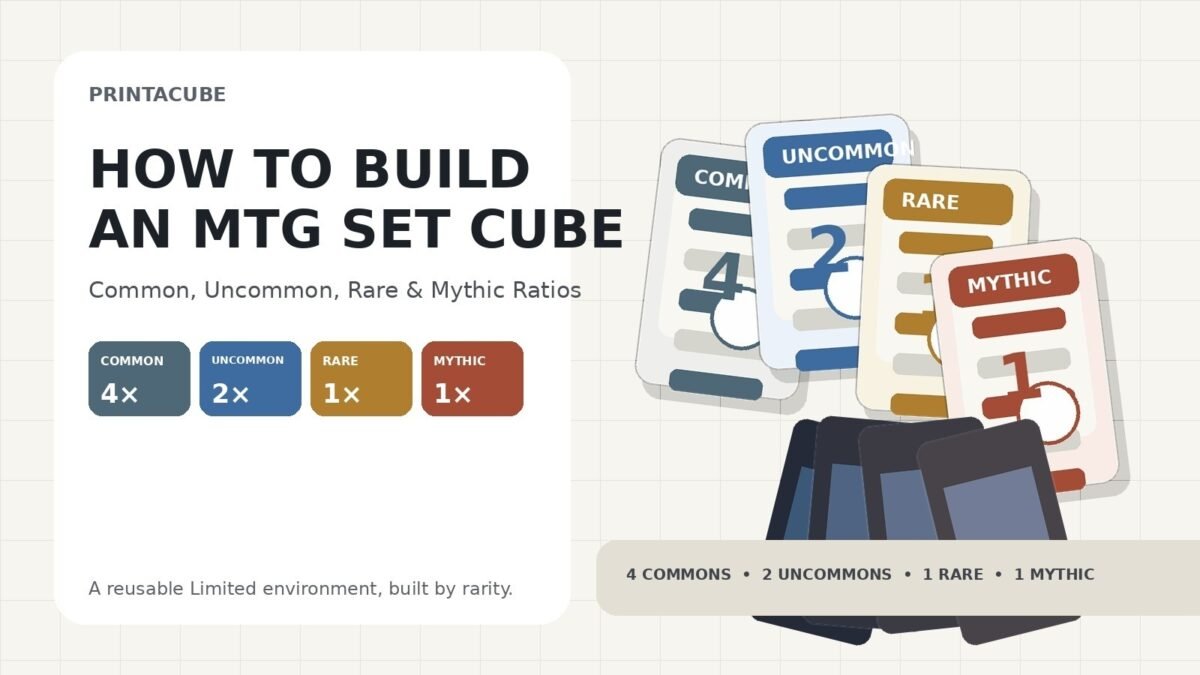
Table of Contents
TLDR
- An MTG set cube is a reusable version of a specific Limited environment. Unlike most cubes, duplicates are expected.
- A 4:2:1:1 ratio is a strong starting point: four copies of each common, two of each uncommon, one of each rare, and one of each mythic rare.
- Your cube ratio and your booster construction are two separate decisions. Owning cards at 4:2:1:1 does not mean you should simply shuffle the whole cube together and deal random packs.
- For older sets, separate cards by rarity and recreate the original Draft Booster structure.
- For newer Play Booster sets, check the actual booster collation for that set. Wildcards, bonus sheets, lands, foils, and special slots can change the Limited environment.
- Keep basic lands, tokens, emblems, and similar game pieces organized separately unless they were genuinely part of the draftable booster structure.
One of the best things about Limited is also its biggest problem: eventually, the set disappears.
Maybe you loved drafting Khans of Tarkir. Maybe Dominaria was the set your group played every Friday for three months. Or maybe a newer release had such a good Limited environment that you already know you will want to draft it again five years from now.
An MTG set cube turns that draft format into something closer to a board game. Instead of opening new boosters every time, you build a reusable pool containing multiple copies of the commons and uncommons, fewer rares, and all the little pieces needed to reconstruct packs.
The question is how many copies you actually need.
For most builders, 4 commons, 2 uncommons, 1 rare, and 1 mythic is a very practical place to start. It is large enough to preserve the repetition that makes retail Limited work, but it does not require storing six copies of every draft common from a 250-card set. Set-cube tools and builders commonly use 4:2:1:1 as a baseline.
But the ratio is only half the job.
What Is an MTG Set Cube?
A normal MTG cube usually pulls cards from many different sets and often follows a singleton rule. A set cube does almost the opposite.
You pick one Limited environment and preserve it.
That could mean:
- one expansion
- a full block from the older three-set block era
- a Masters set
- a Universes Beyond draft environment
- a custom combination of closely related sets
Duplicates are not a flaw here. They are important.
If a draft archetype depends on a common two-mana creature, removal spell, combat trick, or build-around enabler appearing regularly, a singleton version of the set will not behave like the original draft format. PrintACube’s broader guide to cube formats makes the same distinction: set cubes commonly use duplicates specifically because they are trying to reproduce a particular Limited environment.
That is why set-cube construction usually starts with rarity.
The 4:2:1:1 MTG Set Cube Ratio
Here is the simple version:
| Rarity | Copies of Each Card |
|---|---|
| Common | 4 |
| Uncommon | 2 |
| Rare | 1 |
| Mythic Rare | 1 |
So if a hypothetical set contains 80 commons, 60 uncommons, 50 rares, and 15 mythics, the cube would contain:
- 320 common cards
- 120 uncommon cards
- 50 rare cards
- 15 mythics
That is a 505-card set cube before lands, tokens, or other extras.
This is why set cubes can get large surprisingly fast.
But 4:2:1:1 has an important advantage: commons remain common.
You want the bread-and-butter cards of the format appearing repeatedly. If a set’s blue-red deck revolves around a particular common prowess creature, players should be able to draft two or three copies sometimes. If every common appears only once, the draft starts to feel more like a normal singleton cube wearing the costume of the original set.
Is 4:2:1:1 the Most Accurate Ratio?
Not exactly.
It is a convenient ratio, not a perfect simulation of every booster ever printed.
This matters most at rare and mythic rare.
Wizards has explained that rares and mythics can share print sheets with rares appearing more frequently than mythics. In one commonly used sheet structure, each rare appears twice while each mythic appears once.
So if you want tighter rarity simulation, you can use a larger structure such as:
6 commons : 3 uncommons : 2 rares : 1 mythic
That gives each individual rare more representation relative to each mythic.
The problem is obvious once you start multiplying.
A 6:3:2:1 set cube can become enormous.
For most groups, I would rather own a manageable 4:2:1:1 cube and control rarity while building packs than add several hundred cards simply to improve the mathematical simulation.
That leads to the rule that makes set cubes much easier to understand:
Your ownership ratio does not have to be your pack ratio.
Separate Your MTG Set Cube by Rarity
Do not just shuffle a 4:2:1:1 cube into one enormous stack and deal out 15-card piles.
You can do that. Magic will technically occur.
But you lose much of the structure that made the original Limited format work.
Instead, store the cube in rarity sections:
- Commons
- Uncommons
- Rares
- Mythics
- Special or bonus-sheet cards, when applicable
- Lands, when applicable
- Tokens and other game pieces
Shuffle each section independently before draft night.
Then construct packs from those pools.
This lets you use a compact cube while controlling how often higher-rarity cards actually appear.
It also makes cleanup easier. Sorting 500 cards by exact collector number after every draft sounds organized until you actually have to do it. Four or five rarity piles are much less painful.
Building Packs for Older Draft Booster Sets
Older Draft Booster environments are fairly straightforward.
Wizards describes the traditional Draft Booster baseline as typically containing 10 commons, 3 uncommons, and 1 rare or mythic rare, with foil and other slots creating some variation.
For a set built around that style of booster, you can get very close with separate rarity piles.
A basic pack might look like:
- 10 commons
- 3 uncommons
- 1 rare or mythic rare
- 1 appropriate land or other set-specific slot
Or use the exact structure of the original product if the set handled its fifteenth card differently.
The rare slot is where I would control mythic frequency rather than relying on your entire cube’s 4:2:1:1 ownership ratio.
One simple solution is to build a rare/mythic pool where rares have additional weight. Another is to prepare the exact number of rares and mythics needed for the draft before making packs.
You do not need casino-grade collation.
You just want a mythic to feel meaningfully less common than a rare.
Modern Play Boosters Make Set Cubes More Interesting
Modern Play Booster environments require a little more homework.
There is no single pack recipe I would blindly use for every recent set.
Consider Magic: The Gathering | The Hobbit, released in August 2026. Its Play Boosters contain 14 Magic cards, including seven common slots, three uncommon slots, a wildcard slot, a rare or mythic slot, a traditional foil slot, and a land. The wildcard and foil slots can contain higher-rarity cards, so some packs naturally contain more rares than others.
And another recent environment can be different. Secrets of Strixhaven, for example, uses 5–6 regular commons and adds a dedicated Mystical Archive slot on top of its uncommon, wildcard, rare/mythic, foil, and land structure.
That is the big lesson for anyone building a modern MTG set cube:
Recreate the set’s Limited structure, not an abstract idea of what a Magic booster should contain.
Before printing or buying all the cards, look up the official product guide for that particular set.
You Do Not Have to Copy Every Wildcard Percentage
There is a point where accuracy stops improving the draft and starts improving your spreadsheet.
If the original wildcard has a 17.3% chance to be a rare, you probably do not need to create a 1,000-card randomized collation apparatus so your kitchen-table drafts hit precisely 17.3%.
You have a few practical options.
Option 1: Simplify the Wildcard
Make a mixed wildcard pile with commons, uncommons, rares, and mythics in proportions that feel reasonably close to retail.
Deal one wildcard into every pack.
Easy.
Option 2: Prebuild the Whole Draft
For an eight-player draft, build all 24 packs at once.
Decide how many bonus rares or mythics you want appearing across those 24 boosters, then distribute them randomly into the wildcard positions.
This is one of my favorite approaches because the overall draft can resemble retail without requiring every individual pack to obey a complicated probability table.
Option 3: Ignore Cosmetic Collation
If alternate frames and foil treatments do not change gameplay, you can ignore them.
The goal of a set cube is generally to preserve the draft environment, not recreate opening a sealed booster box down to the treatment on card number seven.
What About Bonus Sheets?
Bonus sheets are different because they can change actual gameplay.
Think of sets where every pack includes a card from a separate themed sheet. Those cards can affect picks, archetypes, removal density, and power level.
If a set had one meaningful bonus-sheet card in every draft booster, I would create a separate bonus-sheet section and deal one into each pack.
The same applies to other mechanically relevant guaranteed slots.
Keep them separate during storage and pack construction.
That gives you far more control than shuffling everything together and hoping the distribution works out.
How Many Basic Lands Does a Set Cube Need?
Usually, your draftable cube and your land station should be separate.
After drafting, players need enough Plains, Islands, Swamps, Mountains, and Forests to build their decks. Those cards do not need to occupy space in the main cube unless the set specifically made lands part of the draft experience.
You can reuse the same basic land station every time you draft.
PrintACube also treats basics and tokens as optional additions rather than something every cube automatically needs inside the main card list.
For a normal eight-player draft, having a healthy stack of each basic is much more useful than trying to calculate the theoretical maximum number of Mountains eight people could need simultaneously.
And if your set includes common dual lands, Gates, snow basics, full-art lands with draft relevance, or another special land cycle, determine whether those belong in packs or in the post-draft land station based on how the original format worked.
Do Not Forget the Tokens
Tokens are easy to overlook because they are not part of your primary card list.
Then somebody drafts a deck that produces four different kinds of creatures and the table starts using upside-down commons, dice, and someone’s phone as game pieces.
I like treating tokens as their own small module.
Include:
- creature tokens
- artifact tokens
- emblems
- predefined dungeon or helper cards
- day/night or similar markers when relevant
- keyword reminder cards if the set genuinely benefits from them
You do not necessarily need one token for every token-producing card. You need enough copies to handle realistic board states.
When preparing a cube list for printing, checking duplicates, basics, tokens, and double-faced cards separately can prevent a lot of annoying omissions. PrintACube recommends the same kind of final check when exporting a Cube Cobra list for printing.
Double-Faced Cards Need a Plan Too
Some of the best Limited formats also contain a pile of double-faced cards.
Decide how your group will handle these before printing the cube.
Common solutions include:
- opaque sleeves
- checklist or substitute cards
- printing both faces separately
- keeping reference copies available during the draft
The most important thing is consistency.
A drafter should not be able to identify a particular double-faced card from the back of the sleeve or from a noticeably different physical setup.
A Practical Set Cube Build I Would Start With
If I were preserving a favorite draft environment and did not want the project to take over an entire closet, this would be my default:
Card pool
- 4 of each common
- 2 of each uncommon
- 1 of each rare
- 1 of each mythic
- appropriate copies of mechanically relevant bonus-sheet cards
Storage
- sort commons, uncommons, rares/mythics, and special slots separately
- keep basics in a dedicated land station
- keep tokens in their own section
Draft preparation
- check the original booster structure
- shuffle each rarity independently
- build 24 boosters for an eight-player draft
- seed rarity and special slots
- add wildcard variance only to the level your group actually cares about
That gets you most of the benefit of retail collation without turning draft night into a statistics project.
When Should You Change the 4:2:1 Ratio?
Change it when you can identify a specific gameplay reason.
Go larger if:
- the format depends heavily on multiple copies of commons
- you regularly draft with large groups
- you want greater pack-to-pack variation
- accurate rare/mythic frequency is a major part of the appeal
Go smaller if:
- storage matters
- you usually draft with four people
- you are printing a very large set
- you want the flavor of the Limited environment rather than a near-perfect simulation
You can also curate the set.
Not every card has to survive just because Wizards put it into the original collector-number sequence. Removing an especially poor Limited card or adjusting the quantity of an important archetype piece can make repeated drafts better.
At that point you are no longer creating a perfect reproduction.
That is fine. You are creating your version of the environment.
The Best Set Cube Is the One You Will Keep Drafting
It is easy to get stuck looking for the mathematically perfect MTG set cube ratio.
I would start with 4:2:1:1.
It is understandable, manageable, and flexible. Then put your effort into the part your players will actually notice: pack construction.
Separate the rarities. Reproduce important special slots. Keep enough commons in circulation for archetypes to function. Give mythics the scarcity they are supposed to have. And if a modern set uses complicated Play Booster collation, simplify the probabilities without deleting the gameplay consequences.
You are not running a printing press.
You are trying to make your favorite draft format playable again whenever your group wants it.
That is the part worth preserving.
FAQs
What is the best ratio for an MTG set cube?
A 4:2:1:1 ratio is a strong general starting point: four of each common, two of each uncommon, one of each rare, and one of each mythic. Larger ratios such as 6:3:2:1 can produce more precise rarity relationships but require substantially more cards.
Should I shuffle an entire set cube together?
Usually, no. If you want the cube to resemble retail Limited, separate the cards by rarity and construct packs from those pools. Otherwise, a random pack could contain an unrealistic number of rares or uncommons.
How many packs do I need for an eight-player set cube draft?
A traditional three-pack draft needs 24 packs: three boosters for each of eight players. The number of cards per pack depends on the Limited environment you are recreating.
Do set cubes include basic lands?
A reusable basic land station is usually easier. Include lands in the draft packs only when the original set used a land slot that mattered to the Limited environment.
Do modern Play Booster sets need a different set-cube ratio?
Not necessarily. You can still use 4:2:1:1 as your ownership ratio. What often needs to change is pack construction because modern Play Boosters can include wildcard, foil, bonus-sheet, and other set-specific slots.
References
- Lucky Paper, MTG Set Cube Builder and Set Cubes & More. The builder identifies 4:2:1:1 as a common set-cube structure and discusses rarity-based pack construction.
- Wizards of the Coast, What Are Play Boosters? Explains the transition from traditional Draft Boosters to Play Boosters and their variable rarity structure.
- Wizards of the Coast, Do the Math. Discusses print sheets, as-fan, and rare/mythic distribution.
- Wizards of the Coast, Collecting Magic: The Gathering | The Hobbit. Provides the August 2026 Play Booster collation used as a current example.
- Wizards of the Coast, Collecting Secrets of Strixhaven. Shows how a modern set can use a dedicated bonus-sheet slot in addition to standard Play Booster slots.
- PrintACube, What Are the Most Popular MTG Cube Formats?, Cube Cobra Export, and site FAQ.
Intent Sentence: This post helps MTG players build a reusable set cube by explaining rarity ratios, booster construction, lands, tokens, and modern Play Booster collation, so they can recreate a favorite Limited environment without buying sealed product every time.