
Top 10 Magic: The Gathering Commander Cube Design Tips
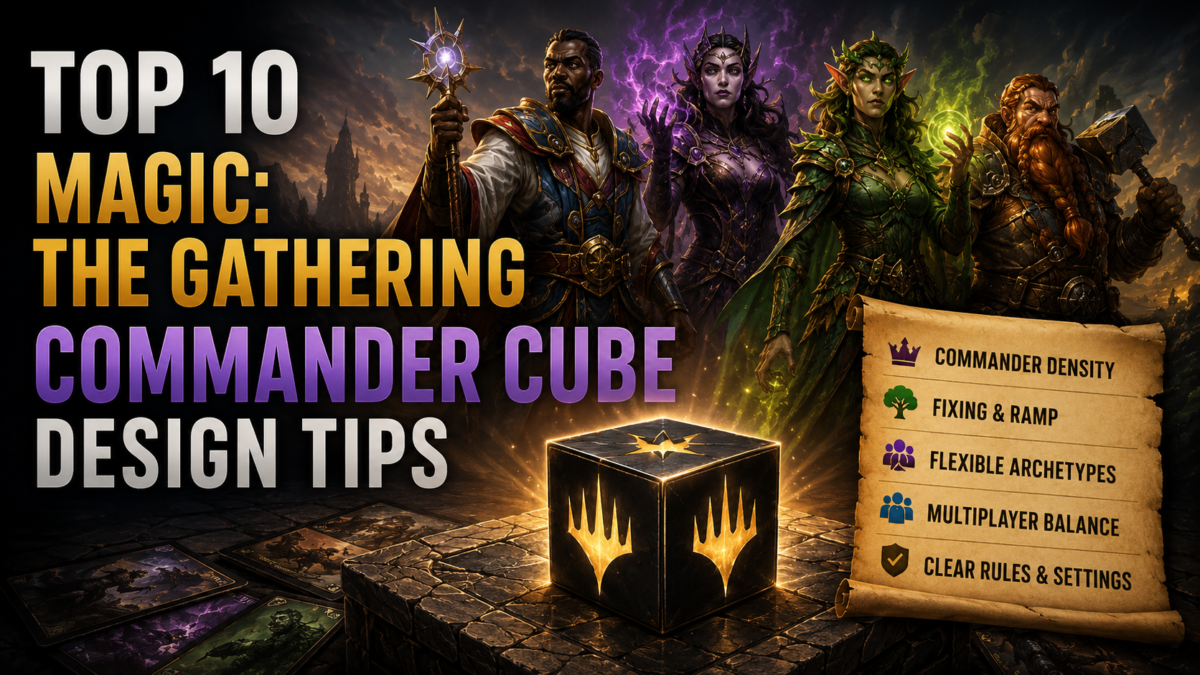
Table of Contents
TLDR
A strong Magic: The Gathering Commander cube needs legendary density, fixing, flexible archetypes, multiplayer pacing, removal, politics, safety-valve commanders, clear deckbuilding rules, enough card draw, and a realistic power band. In other words, it needs more structure than a normal cube because Commander players can turn even a simple board state into a town hall meeting.
Magic: The Gathering Commander cube design is different from regular cube design because players are not just drafting cards. They are drafting identity, color access, multiplayer engines, and the right to say “I promise I am not the threat” while clearly being the threat.
A normal cube wants clean 40-card decks and strong one-on-one games. A Commander cube wants draftable legends, color identity support, multiplayer pacing, and enough flexibility that nobody ends up with 59 cards and a commander they deeply resent. PrintACube’s guide to Commander MTG Cube is a good starting point if you are deciding whether this style fits your group.
1. Add More Commanders Than You Think You Need
Commander cube needs a high density of legendary creatures and commander-eligible options. Players need to see commanders early enough to build around them, but not so many that every pack becomes a parade of legends nobody can use.
The exact number depends on cube size and draft method, but the principle is simple: players should not feel trapped. If someone drafts a few strong black-green cards, they should have a reasonable shot at finding a commander that supports those colors.
Many Commander cubes also include partner-style options or flexible commanders to reduce draft failures.
2. Use Safety-Valve Commanders
A safety-valve commander is a fallback option that prevents players from being stranded. The Prismatic Piper is the famous example from Commander draft products, but custom cube rules can serve the same purpose.
This matters because Commander cube has a unique failure state: a player drafts a pile of cards but cannot legally assemble a deck around a commander. That is not an exciting deckbuilding puzzle. That is a customer service incident.
Give players a backup path.
3. Prioritize Mana Fixing
Commander cube needs more fixing than regular cube. Players draft around color identity, often play more colors, and need to cast spells in longer multiplayer games.
Fixing lands, mana rocks, treasures, green ramp, and flexible duals all help. Without enough fixing, players will draft exciting multicolor cards and then spend games staring at the wrong lands like the lands personally betrayed them.
The more colors your commanders encourage, the more fixing your cube needs.
4. Build Archetypes That Overlap
Commander cube archetypes should overlap even more than normal cube archetypes. Lifegain, sacrifice, tokens, artifacts, graveyard, spells, counters, blink, and lands can all connect through shared cards.
Overlap lets players pivot when their first plan dries up. It also helps multiplayer games because decks need enough redundancy to function across longer games.
Avoid archetypes that only work for one commander. That creates a private mini-game for one drafter and a pile of dead cards for everyone else.
5. Respect Multiplayer Removal
Removal changes in Commander cube. One-for-one answers still matter, but multiplayer games often need broader tools: board wipes, flexible removal, graveyard hate, artifact and enchantment answers, and ways to answer commanders repeatedly.
Do not rely only on creature removal. Commander games often revolve around enchantments, artifacts, graveyards, lands, and engines that do not politely stand in the creature zone waiting to be Doom Bladed.
Include answers that different colors can access.
6. Keep the Power Band Honest
Commander players love saying decks are casual. Then someone casts a fast mana start into a value engine and explains that it is “just synergy.” Wonderful.
A Commander cube needs a clear power band. Decide early whether the environment is casual battlecruiser, tuned mid-power, high-power, or closer to cEDH-style efficiency. Then include cards that support that decision.
Wizards now describes Commander with optional brackets for matching expectations, which is a useful reminder that power conversations matter before games start. Commander cube is no different.
7. Include Enough Card Draw
Multiplayer games go long, and players need resources. If your Commander cube does not include enough card draw, players will run out of things to do and begin topdecking. Topdecking can be dramatic. It can also be 40 minutes of people saying “land, go” with the enthusiasm of a tax appointment.
Every color should have access to card flow in ways that match its identity. Blue draws. Black pays life. Green uses creatures. Red impulsively exiles and rummages. White uses small creatures, tokens, equipment, and catch-up tools.
8. Make Politics Real But Not Exhausting
Commander cube should allow table politics, but the cards should not require constant negotiation to function. Voting cards, goad, monarch, initiative-style pressure, and attack incentives can create fun table talk.
But if every card asks players to negotiate, choose modes, vote, redirect, or form temporary alliances, games slow down. A little politics is seasoning. Too much is a committee meeting with sleeves.
Use political cards that move the game forward.
9. Decide Deck Size and Draft Rules Up Front
Commander cube varies more than normal cube. Some groups build 60-card Commander decks. Some use larger decks. Some use partner rules, background-style rules, free fixing rules, or special commander selection rules.
Write the rules down. Seriously. Do not rely on “we all know how this works,” because someone will interpret that as permission to build five-color nonsense with three commanders and a dream.
Clear rules help new drafters enjoy the format instead of trying to reverse-engineer your house format mid-draft.
10. Print and Store It Like a Shared Game
A Commander cube is not just a card list. It is a reusable tabletop product. Keep it organized, sleeved, randomized, and easy to draft. Include tokens, basics, commander markers, and any house rules in the box.
PrintACube’s MTG proxy cube category shows how cube products can be organized around complete draft environments, from Modern and Legacy cubes to Commander and micro cube options. For adjacent Magic reading outside pure cube design, Culture of Gaming is also an approved resource to keep in the broader gaming orbit.
Good logistics will not make a bad cube good. But bad logistics can make a good cube feel like homework with dragons.
FAQs
What is a Commander cube?
A Commander cube is a curated draft pool designed so players can draft Commander-style decks, usually with legendary creatures, color identity rules, multiplayer gameplay, and more fixing than normal cube.
How many commanders should a Commander cube include?
Enough that every drafter has multiple realistic options. The exact number depends on cube size, pack structure, and whether you use partners or fallback commanders.
Is Commander cube good for new players?
It can be, but only if the power level and rules are clear. Commander cube asks players to draft, build, and think about multiplayer politics, so it is more complex than normal cube.
Should Commander cube use 100-card decks?
Not necessarily. Many Commander cube groups use smaller deck sizes to make draft and deckbuilding practical. The important part is consistency and clarity.
References
Wizards of the Coast: Commander Format
Wizards of the Coast: MTG Formats
PrintACube: Commander MTG Cube
PrintACube: MTG Proxy Cubes
Culture of Gaming: Culture of Gaming